It’s not just about the numbers: in search of the tourism of tomorrow
More and more people are travelling, and regions are increasingly feeling the consequences. The Federal Foreign Office invited international experts to come to Germany in search of solutions.
 Klaus Lüber
 Once a year, the whole world comes to Berlin to portray itself in the very best light. Strolling through the kilometres of exhibition halls at the ITB Berlin travel show, past gigantic LED screens featuring spectacular natural scenery, sun-drenched cities and happy faces, you get a good impression of just how huge the travel industry is. 6,000 exhibitors from 166 countries around the world were represented at the 60th ITB in early March 2026, and 97,000 international trade visitors flocked to the German capital to discuss new trends. International tourism is one of the most important pillars of the global economy - accounting for nearly ten percent of global GDP, it provides roughly one in ten jobs worldwide. In 2025, 1.6 billion people went on trips to other countries, more than ever before.
Success comes at a price, however: “Many regions are now suffering from mass tourism,” says Dr Efthymia Sarantakou. She is a researcher at the University of West Attica’s Department of Tourism Management in Athens. “We need to take a much more participatory approach to tourism in future. Local populations have to be directly involved in planning processes.” Mark Aoun agrees. “There is great demand for travel experiences off the beaten track.” Aoun is the founder of a Lebanese non-governmental organisation for ecotourism and has been working for many years to embed travel experiences at the local level to a much greater extent than was the case in the past. Together with the German embassy in Beirut, he initiated the Green Village Project to promote sustainable village tourism.

Dieses YouTube-Video kann in einem neuen Tab abgespielt werden
YouTube öffnenThird party content
We use YouTube to embed content that may collect data about your activity. Please review the details and accept the service to see this content.
Open consent formLocal communities must profit and cultural heritage must be protected
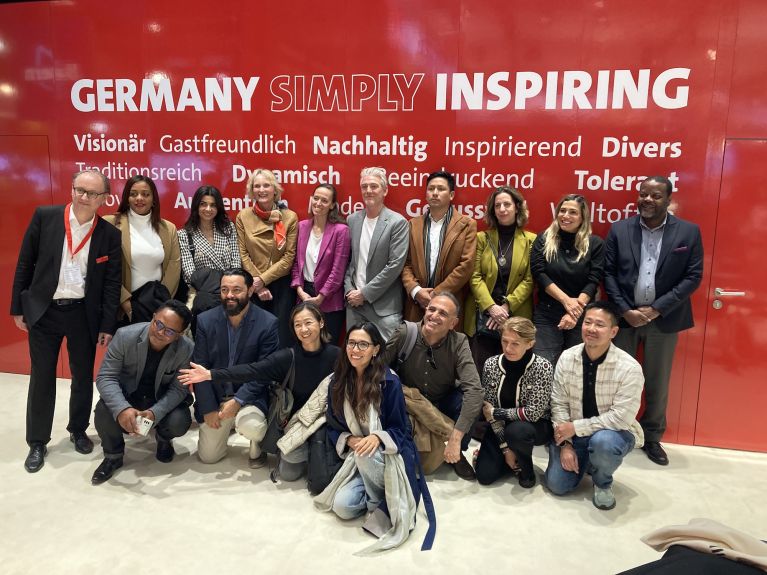
Sarantakou and Aoun took part in the Visitors Programme of the Federal Republic of Germany. Alongside international colleagues from the travel industry, including many journalists, they spent a week seeing for themselves how Germany is positioning itself in the area of sustainable tourism. A visit to the ITB was one of the highlights of the packed programme. Adriana Elizabeth Marquez Acevedo from Ecuador is a travel journalist who has been to 59 countries over the past ten years. This was her first visit to the ITB. “That was a very special experience for me and I was really impressed by the variety of offerings and approaches.” This year’s ITB slogan, “Leading Tourism into Balance”, fits in very well with her goals. Like everyone else in the group, she is interested in opportunities for responsible travel. She wholeheartedly endorses the view of Shaikha Al Nowais, the secretary-general of UN Tourism, who also visited the ITB: “Tourism today finds itself at a crossroads. We can no longer measure success in terms of how many visitors arrive at their destinations, but in terms of how local communities profit, how cultural heritage can be protected and how emissions can be reduced.”

Dieses YouTube-Video kann in einem neuen Tab abgespielt werden
YouTube öffnenThird party content
We use YouTube to embed content that may collect data about your activity. Please review the details and accept the service to see this content.
Open consent formHow a national park is managing visitor flows
So, how exactly can the tourism of the future be brought into a healthy balanced state? And what strategies is Germany pursuing to this end? In Mecklenburg-Western Pomerania the group visited Jasmund National Park on the island of Rügen, whose beech forests have been listed as a UNESCO World Heritage Site since 2011. The park keeps track of visitor numbers to protect sensitive areas from overcrowding. The region’s hotels, tour operators and restaurants are required to meet sustainable standards. The park also cooperates with German rail operator Deutsche Bahn to encourage as many visitors as possible to travel there without a car. “That’s exactly the right approach,” praises Aoun. “I’m impressed by what Germany is doing here.”
At Stralsund University of Applied Sciences, the group was introduced to the master’s programme in Tourism Development Strategies. One special feature of the degree course is the consistent way in which training is transferred directly into practice: students go straight from the lecture theatre to work in international tourism - taking part for example in international excursions and projects with companies. This is an approach that Sarantakou would also like to see her university embrace. “Sustainable tourism remains just an empty promise if you don’t teach people the skills with which to achieve it.”

Dieses YouTube-Video kann in einem neuen Tab abgespielt werden
YouTube öffnenThird party content
We use YouTube to embed content that may collect data about your activity. Please review the details and accept the service to see this content.
Open consent formGermany’s new tourism strategy
As the group learnt during a visit to the Federal Ministry for Economic Affairs and Energy (BMWE), one of the German government’s main goals is to reduce bureaucracy in order to make firms in the tourism industry more competitive. To this end, Germany’s National Tourism Strategy was adopted in January 2026. Overregulation is a challenge for other countries, too. Thuan Luca Nguyen Dinh, a postdoc at the University of Malta, presented a digital platform that helps companies comply with official government requirements. “It’s often a real jungle of regulations.”
The Japanese and their love of the Black Forest
The ITB visit was followed by a concert at Berlin’s Philharmonie concert hall. As travel journalist Hiromi Suzuki explains on her way back to the hotel, the concert venue is famous in Japan. Her work frequently brings her to Berlin. One reason she really likes the city is because it’s so different to Tokyo, where she lives and works. But she loves the Black Forest most of all. “Tourism,” says UN Tourism Secretary-General Al Nowais, “has a unique power. It brings together people, cultures and economies, creates livelihoods and increases cross-border understanding.”


