Strengthening ASEAN: “Lifeblood of the global economy”
With trust in a rule-based global order, the Deutsche Gesellschaft für Internationale Zusammenarbeit (GIZ) is focusing on the Association of Southeast Asian Nations (ASEAN).
The elephant is in the room - and crashing its way through a world that is coming apart at the seams. “It is time to address the elephants in the room”. That’s what the current teaser video for the Munich Security Conference (MSC) demands. The Munich Security Report, an analysis of international politics that the MSC presents each year, has a title that is intended to alarm: “Under Destruction”. This is a reference to attacks on the current global order, including from protectionist US policy, Chinese power projections and the erosion of multilateral institutions.
Dieses YouTube-Video kann in einem neuen Tab abgespielt werden
YouTube öffnenThird party content
We use YouTube to embed content that may collect data about your activity. Please review the details and accept the service to see this content.
Open consent form“We are currently experiencing not only a further phase in the realignment of the international order; at the same time, central assumptions upon which this order is based are being actively questioned and systematically dismantled,” explained Tobias Bunde, the MSC’s director of research and policy, when the report was presented in February 2026. The report carries considerable weight and has evolved in recent years to become one of the most important studies of the global political situation.
Numerous states and international institutions are responding to the “wrecking-ball politics” by investing in their own power resources and seeking closer cooperation. Germany is also attempting to hold its own and reposition itself in security policy terms – and to defend the free global trade upon which much of its prosperity depends. In this context, alliances not only in Europe but also in the Indo-Pacific are becoming increasingly important.
German foreign minister visits Southeast Asia
Recently, Germany’s Foreign Minister Johann Wadephul therefore visited the Asia-Pacific region once again to strengthen alliances and present Germany as a partner. “We are living in times when old certainties that our prosperity and security rested on for decades are crumbling,” he said at the start of his trip. He explained that talks in Singapore, New Zealand, Tonga, Australia and Brunei would be aimed at expanding trade with the region to become more economically independent of the USA: “Together, we advocate for clear rules to govern international relations when these come under pressure - in Europe as in the Indo-Pacific.” Wadephul made it clear that what happens in Indo-Pacific has an impact on Germany and Europe - and vice versa. Ten years ago, Germany and the Association of Southeast Asian Nations, or ASEAN for short, entered into a development partnership.
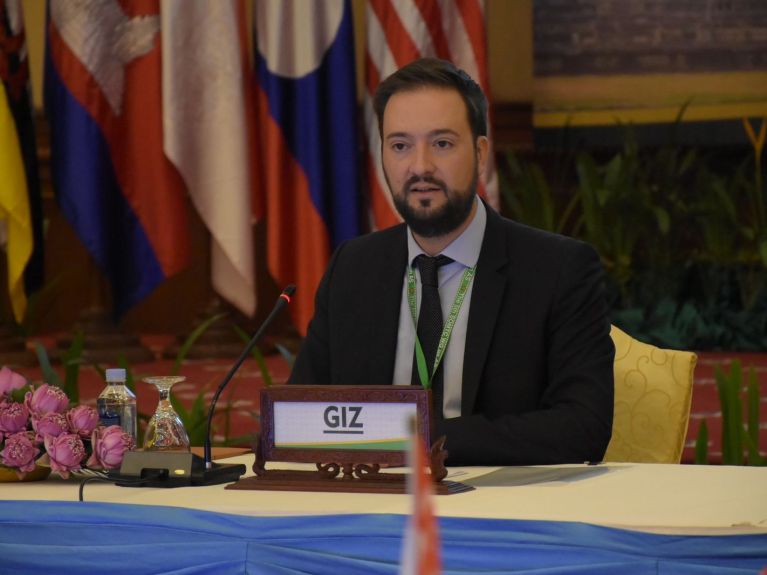
“ASEAN has continuously evolved in the direction of stability and understanding.”
Founded in 1967 and now made up of eleven Southeast Asian nations, ASEAN has been an important focus for Germany for many years. “ASEAN and the EU are organisations that continue to preserve a rule-based order,” says Michael Weiss, project manager with the Deutsche Gesellschaft für Internationale Zusammenarbeit (GIZ). “The association is becoming more attractive economically. It has continuously evolved in the direction of stability and understanding and admitted new members such as Timor-Leste.” He explains that Germany, with the support of the ASEAN Secretariat, is strengthening an organisation for around 670 million people.
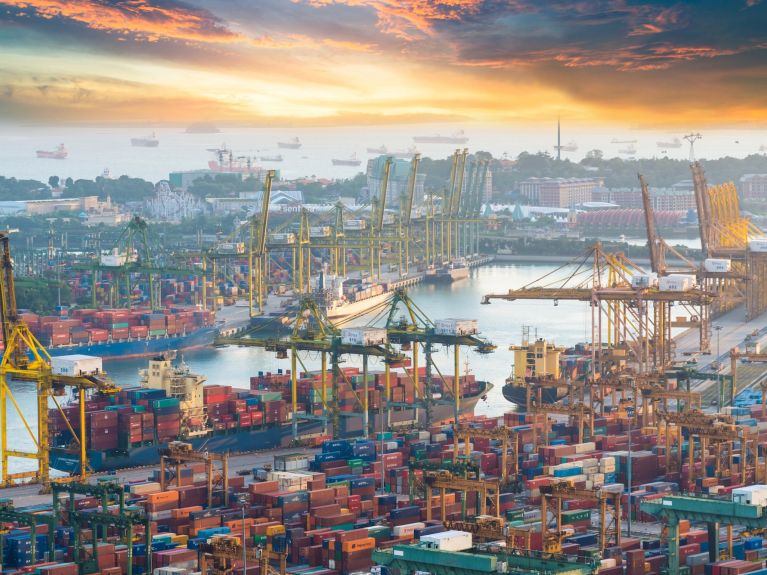
In turn, secure trade routes and reliable political partnerships are important for Germany. “The shipping routes in Southeast Asia are the lifeblood of the global economy,” says Weiss. GIZ runs many projects in the region on behalf of the German government, aimed at providing ASEAN with institutional support; it has maintained a presence in the region with country and project offices for more than half a century.
Reliable information in an era of fake news
“In the past ten years, ASEAN, its secretariat and its affiliated entities have evolved professionally,” says Weiss. “The association has become a firm fixture in Southeast Asia.” Since its founding, ASEAN has also worked to establish its own “ASEAN identity”. All the same, many people in the region are hardly aware of the association’s integration - and that is putting the brakes on reforms. That’s why Michael Weiss and his six-member GIZ team have set up platforms at the ASEAN Secretariat to strengthen integration processes in all eleven member states. For example, the 2026 ASEAN Media Forum in the Philippines aims to bring publishers, media companies, smaller editorial offices and freelancers together with a view to promoting reliable information flows in an era of fake news. In addition, GIZ supported the Secretariat in developing strategic communication plans and institutionally strengthening disaster protection.
Such small-scale projects also make ASEAN more stable. After all, its members have to deal with internal conflicts at the same time. For example, the recent border dispute between Cambodia and Thailand had changed the course of projects and the involvement of representatives. However, ASEAN has principles and established mechanisms in place to resolve conflicts, explains Weiss. These must be consistently applied, he believes. This could demonstrate that institutional patience and reliable rules create stability in a world in which order is increasingly becoming a matter of negotiation. This constitutes a clear alternative to wrecking-ball politics.
At the Munich Security Conference, GIZ is organising a side panel at which, among others, Philippine Foreign Minister Ma. Theresa P. Lazaro will talk about maritime security. She chaired the ASEAN Foreign Ministers’ Retreat in the Philippines in January 2026 – the first major meeting under the Philippines’ ASEAN chairship. In an interview with GIZ, ASEAN Secretary-General Kao Kim Hourn explains the value of the partnership between Germany and the association.


