Why is Germany’s democracy so well protected?
Germany drew crucial lessons from the failure of the Weimar Republic. They continue to shape the Basic Law and German democracy to this day.
 Stefanie Hardick
- The failure of the Weimar Republic: In 1933, the National Socialists used their power to abrogate democratic rights and to establish a dictatorship within a matter of months.
- Learning lessons from history: The Basic Law, which was enacted in 1949, is designed to prevent democracy being abolished by democratic means.
- Protecting democracy: The eternity clause protects fundamental principles such as human dignity, democracy and the rule of law. Under certain strict conditions, political parties can be banned.
- The responsibility of the people: Laws and institutions alone are not sufficient. A democracy needs people to support and defend it.
Berlin, 30 January 1933. That evening, tens of thousands of people carrying burning torches march through the government district in Berlin. Members of the National Socialist SA and SS, and of the right-wing nationalist Stahlhelm organisation, parade through the Brandenburg Gate to the Reich Chancellery. Supporters cheer on the participants, while curious onlookers observe the parade. Adolf Hitler, who was appointed Reich Chancellor just a few hours earlier, watches the procession from the window. Germany has been a democracy, for the first time in its history, for just under 14 years. The days of the Weimar Republic are numbered, however.
How were the Nazis able to destroy Germany’s first democracy?
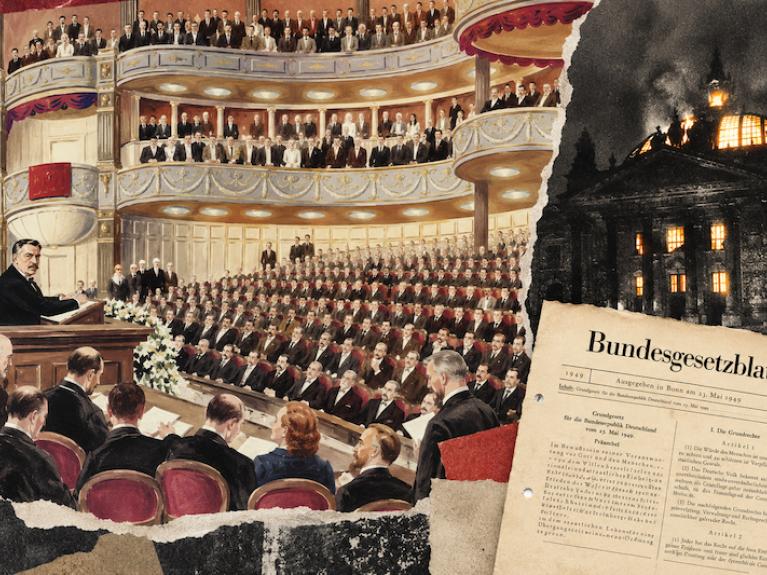
Hitler didn’t come to power as the result of a violent revolution. Reich President Paul von Hindenburg appointed him Reich Chancellor in full accordance with the regulations of the Weimar Constitution. “Many politicians at the time were anti-democratic. They made Hitler chancellor because they thought they could control him,” explains political scientist Michael Dreyer. He is chairman of the board of the organisation that runs the Haus der Weimarer Republik memorial site. Just four weeks later, the Reichstag - the German parliament - was on fire. The Nazis used the state of emergency to suspend fundamental civil liberties and persecute political opponents. They established a dictatorship within just a few months.
What was the Basic Law supposed to do better?
The “mothers and fathers” of the Basic Law, who drafted the new constitution in 1948 and 1949, had experienced the failure of the Weimar Republic at first hand. Michael Dreyer explains: “Many had been persecuted by the National Socialist regime. Some had spent years imprisoned in concentration camps, while others were forced to flee the country.” They wanted to prevent Germany from ever again becoming the starting point for terror, systematic genocide and a war of aggression. That’s why the new constitution was intended not only to guarantee democratic rights but also to prevent democratic freedoms from being exploited to abolish democracy itself. This provided the Federal Republic of Germany with the tools to defend itself against enemies of the constitution. This is the basic idea behind “defensive democracy”.
Was the Weimar Republic then defenceless?
On the contrary: “The Weimar constitution was the world’s most modern constitution,” says Michael Dreyer. “It served as a model for many countries, including Austria, Finland, Greece, Taiwan and many Latin American states.” Protective mechanisms were also already in place. For example, it was easier to ban anti-constitutional parties than it is today. This was evident in 1923 when Hitler attempted to seize power via a coup: his party, the NSDAP, was banned. It was able to reform in 1925, however. “There were many reasons why the Weimar Republic ended,” says Michael Dreyer. “But it wasn’t because of the constitution.”
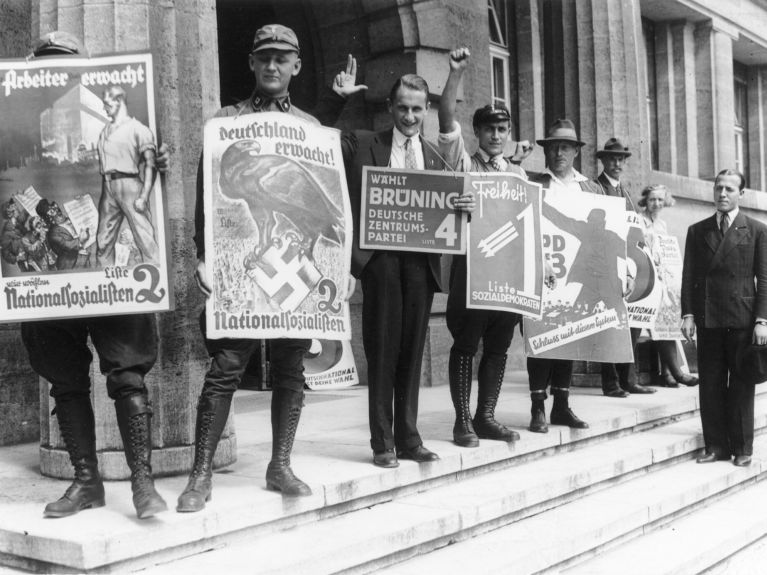


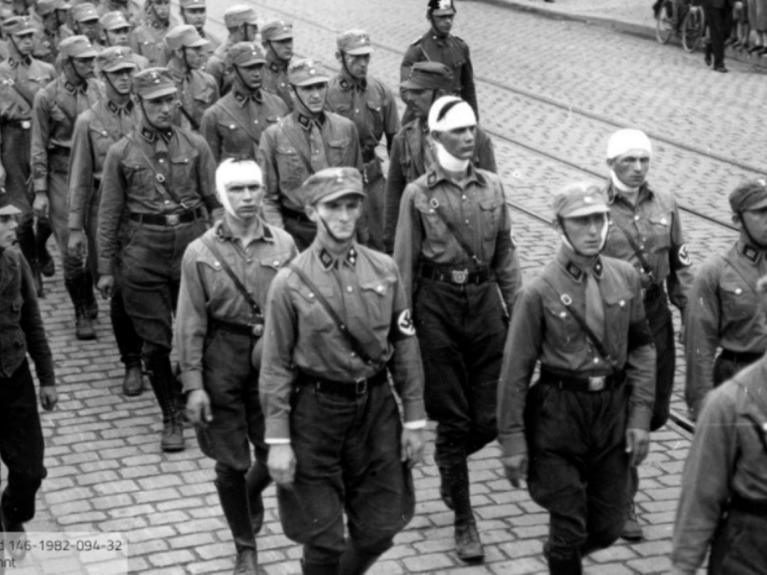
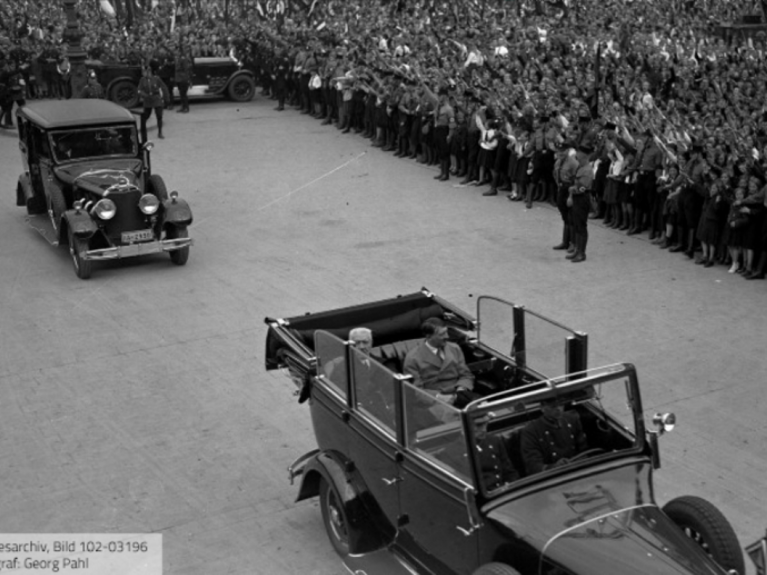

The key factor was that the democratic institutions and political actors did not sufficiently protect the Republic. Those who drafted Germany’s Basic Law drew lessons from this: they were determined to ensure greater constitutional protection of democracy.
How does German democracy protect itself against its enemies?
The Basic Law features a variety of protective mechanisms. The so-called eternity clause plays an especially important role. It stipulates that certain fundamental principles in Germany cannot be abolished, even by a parliamentary majority. Imagine the Basic Law like a house: individual rooms in it can be changed but the supporting walls cannot be torn down. These inviolable principles include human dignity, the principle of democracy and the principle of the rule of law.
Another instrument is the possibility to ban political parties. The Federal Constitutional Court can ban a party that actively seeks to undermine or abolish the free democratic basic order. It is not enough for a party to pursue anti-democratic objectives, however. There must also be concrete reasons to believe that it could achieve these objectives.
In the history of the Federal Republic of Germany, two parties have been banned to date: the right-wing extremist Socialist Reich Party (SRP) in 1952 and the Communist Party of Germany (KPD) in 1956. The high barriers to banning a party are intended to prevent the instrument from being misused to eliminate unwanted political rivals.
The Weimar constitution was the world’s most modern constitution.
Can a constitution alone protect a democracy?
Laws and institutions can protect a democracy. But whether it will endure will also depend on how people approach their democratic responsibility. This is where Michael Dreyer sees a crucial difference between the Weimar Republic and the Federal Republic of Germany: “The most important difference to the Weimar Republic lies in the people who are in power in Germany today: they support democracy.”
At Theaterplatz in Weimar, opposite the German National Theatre, the Haus der Weimarer Republik commemorates the beginnings of German democracy. It was at the National Theatre that the National Assembly adopted the Weimar Constitution in 1919. Today, the museum brings the history of the Republic to life.


