Help for Ukrainian war victims: new mobility thanks to prostheses
They are forging new paths despite severe injuries: how a German company and its Ukrainian partners are responding to the horrors of war.
 Johannes Göbel
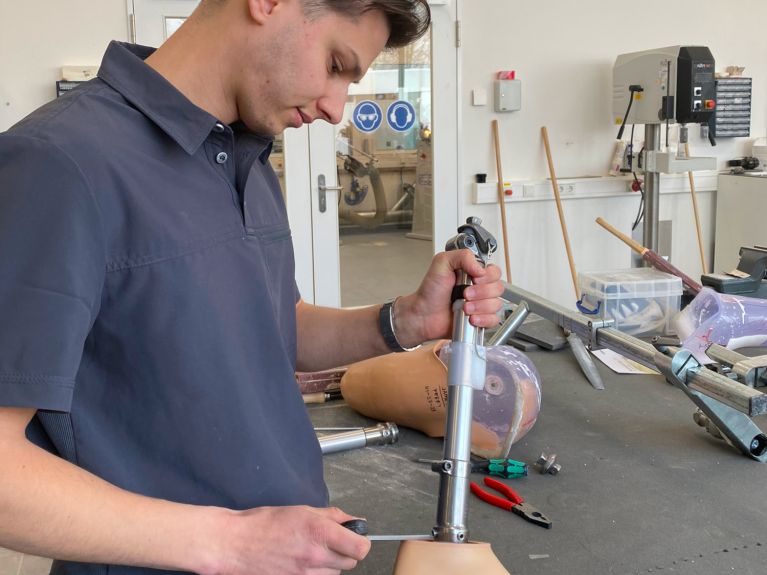
 Oleksii Borysov is an orthopaedic technician in Ukraine and witnesses on a day-to-day basis the serious injuries caused by Russian attacks alongside the many fatalities. After amputation of the lower or upper legs, soldiers – and civilian victims – have to be fitted with prosthetic limbs. Borysov works for the Ukrainian non-profit organisation Superhumans and specialises in lower-leg prostheses. “When people come to us in wheelchairs and are then able to walk again with their prostheses, that makes me happy,” says the 27-year-old, who shows no outward sign of the strain of life under a state of emergency. Like so many Ukrainians, Borysov is doing extraordinary work in the face of the war: constantly at risk of becoming a victim of Russian attacks himself, he focuses on the precision work involved in prosthetics – the sophisticated interplay of electronics and mechanics that restores mobility to patients.
Training programme for orthopaedic technicians
The organisation Superhumans provides Ukrainian war victims with prostheses, plastic surgery, rehabilitation measures and psychological support. It is supported in its work by German prosthetics manufacturer Ottobock. Since the start of Russia’s full-scale invasion of Ukraine in February 2022, the company has expanded its training and education programmes in order to address the shortage of orthopaedic specialists in Ukraine. “In the past four years, we’ve organised training for more than 150 orthopaedic technicians,” says Anatoli Tirik, who is regional sales manager for Eastern Europe and therefore also responsible for Ukraine. The training took place at the company’s headquarters in Duderstadt in Lower Saxony, but also at customers’ rehabilitation centres in Azerbaijan and Georgia. “We started with a small group of trainees in 2022. Step by step, we’ve expanded the further training programme under the umbrella of the Ottobock Global Academy.”
Substantial demand for leg prostheses
Frederik Thiede is a master orthopaedic technician and heads the lower-limb prosthetics division at the Ottobock Global Academy. He says: “At the academy we offer a wide range of courses for the basic training of orthopaedic technicians, as well as courses on specialisations.” Because of the many amputations resulting from war injuries, there is a substantial demand for leg prostheses in Ukraine. “We’re responding to this demand by providing intensive courses lasting six to 12 weeks; this was a new challenge.” The Global Academy team has also learned a great deal, he adds: “We’ve done a lot of translating into Ukrainian and developed new ways of transferring expertise.”
High-tech solutions for patients
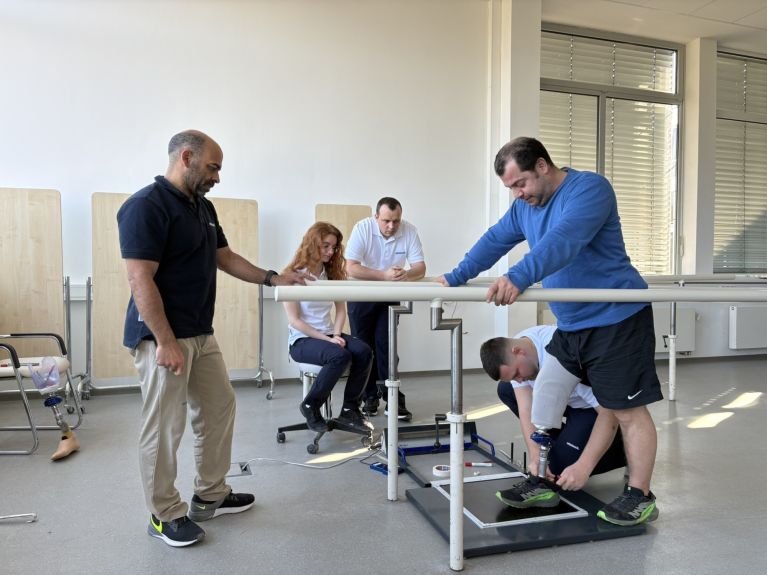
Oleksii Borysov attended his first 12-week training course in Duderstadt together with nine other Ukrainian participants in February 2024. “That taught us what’s important when assembling prostheses,” he says. Working on these highly advanced prostheses involves a range of different aspects: in order to provide users with the best possible mobility, for example, prostheses have to be precisely adapted, or microprocessor-controlled knee joints have to be adjusted. “We looked at all the technical and biomechanical components of the prostheses,” says Borysov. He says the work with patients who took part in the course for testing and demonstration purposes was particularly valuable. “They gave us feedback on how we’d adapted the prostheses to their bodies.”
Ottobock’s technical expertise is in demand in numerous conflict and crisis regions around the world: in recent years, aid operations have brought children from Gaza to neighbouring countries to ensure prosthetic care at partner facilities, for example, and the medical infrastructure in the Turkish-Syrian border region was improved following the earthquake disaster in February 2023. Workshops have been set up in cooperation with aid organisations in Ukraine, including in Kyiv and Lviv. The company also supplies patients in Russia with prostheses – something that has occasionally attracted criticism. Ottobock emphasises that these are used exclusively for civilian patients, however.
New German-Ukrainian friendships
Ottobock has maintained business relations with Ukraine for more than 30 years. The cooperation with Superhumans, which began in October 2022, has been able to build on these existing contacts: “Four representatives of the organisation visited us at our headquarters in Duderstadt at that time,” says Anatoli Tirik. “They were keen to find out more about our prostheses and how they benefit patients, but they didn’t have technicians with the necessary expertise.” In recent years, conversations between the guests from Ukraine and Tirik have not only centred on technical matters: “I’ve shown them some of Germany, too – for example Nuremberg, where I live. Genuine friendships have developed.”


