Germany continues to stand firmly by Ukraine’s side
For four years, Russia has been waging its illegal war of aggression against Ukraine. Germany’s assistance is comprehensive - and remains indispensable.
It happened without warning and without cause: on 24 February 2022, Russia invaded Ukraine with tanks, artillery, fighter jets and tens of thousands of soldiers - a war of aggression against a democratic and sovereign state. The past few winter months have made it abundantly clear yet again just how much the Ukrainian civilian population in particular has suffered as a result of the war. There are drone and missile attacks on a massive scale almost every day, targeting above all Ukraine’s energy infrastructure. Tens of thousands of people have left the capital Kyiv, which has been particularly badly hit.
According to the United Nations Human Rights Monitoring Mission in Ukraine (OHCHR), more than 14,500 civilians - including over 760 children - were killed in Russian attacks and massacres between the start of the war and the end of 2025. Figures from the Center for Strategic and International Studies (CSIS) in Washington show that around two million people had been killed or injured or were missing as a result of the war by the start of 2026. And there’s no end in sight.
Wide-ranging support
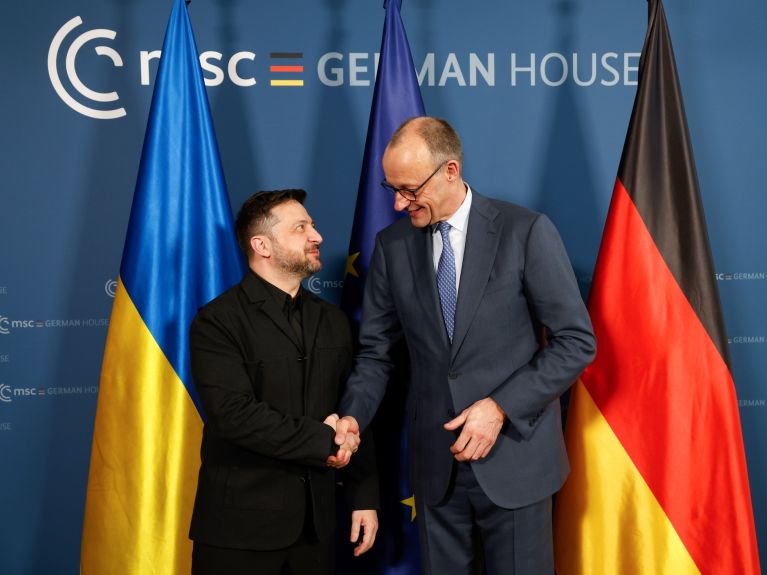
Germany stands firmly by Ukraine’s side. Speaking before the Bundestag in late January 2026, Federal Chancellor Friedrich Merz said that Germany needed to take steps to guarantee its own security and reduce its dependencies. He said this also included “continuing to support Ukraine in its struggle for freedom in Europe”. Just three days after war broke out, Germany’s then Chancellor Olaf Scholz declared a “Zeitenwende” - an epochal shift - in German foreign and defence policy, announced a special fund of 100 billion euros for the Bundeswehr, the country’s armed forces, and pledged wide-ranging support to Ukraine. Speaking in Brussels in February 2026, Defence Minister Boris Pistorius said: “Russia has not changed its strategy in any way. Which is why we must plan to continue providing our support for years.”
Germany provides political, financial, military and humanitarian support:
- by mid-February 2026, Germany had provided bilateral civilian support worth a total of 39 billion euros, while military support had amounted to around 55 billion euros.
- This includes tanks, air defence systems, artillery, ammunition, training and supplies. Leopard 2 and Leopard 1 battle tanks, Marder infantry fighting vehicles, Patriot and IRIS T systems have been delivered, among other military hardware.
- Since the beginning of the war, the Bundeswehr has trained around 24,000 Ukrainian soldiers.
- In addition, Germany is involved in the European ammunition initiative aimed at continuously supplying Ukraine with artillery ammunition.
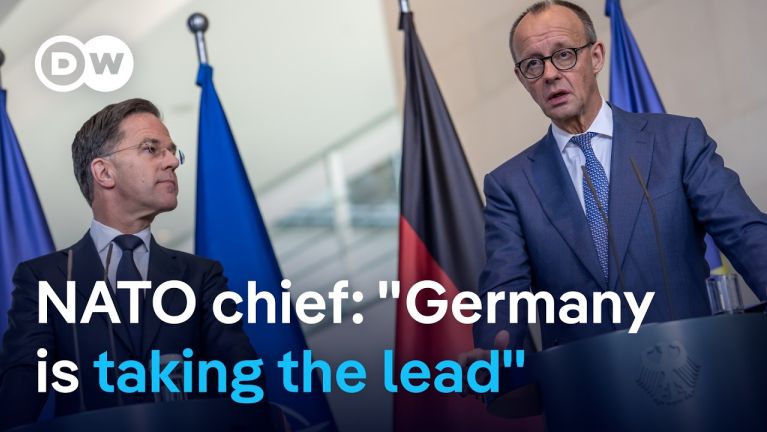
Dieses YouTube-Video kann in einem neuen Tab abgespielt werden
YouTube öffnenThird party content
We use YouTube to embed content that may collect data about your activity. Please review the details and accept the service to see this content.
Open consent formComprehensive humanitarian assistance
Germany is also assuming considerable humanitarian responsibility:
- more than 1.3 million registered refugees had arrived in Germany from Ukraine by mid-January 2026. If they need it, refugees are provided with state support, access to German courses, further training and integration services and help with finding work.
- Within Ukraine, Germany is providing comprehensive humanitarian assistance – from winter aid and emergency energy assistance to mine clearance, medical care, and training and equipment for emergency rescue teams close to the front line.
- The Federal Foreign Office, which is in charge of providing this support, had made over three billion euros available for purely humanitarian assistance by the end of 2025.
- Furthermore, numerous private associations and NGOs in Germany are committed to supporting people in Ukraine. They collect donations and send aid supplies to front-line regions - in some cases at great risk.
Germany plays key role
In February 2026, Foreign Minister Johann Wadephul made it clear: “Ukraine has proven that it can hold its own if the West remains united. Germany plays a key role in this - in military and moral terms.” This was also evidenced by the Ukraine summit in Paris in early January 2026, at which Chancellor Merz, France’s President Emmanuel Macron, UK Prime Minister Keir Starmer and US representatives signed a five-point declaration for international monitoring of a future ceasefire.
Security experts also stress the vital role Germany plays in Ukraine’s defence and efforts to end the war. Carlo Masala from the University of the Bundeswehr Munich told German public service broadcaster ZDF: “Germany has long since evolved from onlooker to decisive player. The greatest danger is domestic policy fatigue - that would be Russia’s greatest success.” Claudia Major from the German Marshall Fund told international broadcaster Deutsche Welle: “Germany’s understanding of security has changed radically since 2022. Today, defence capability is part of peace.”


