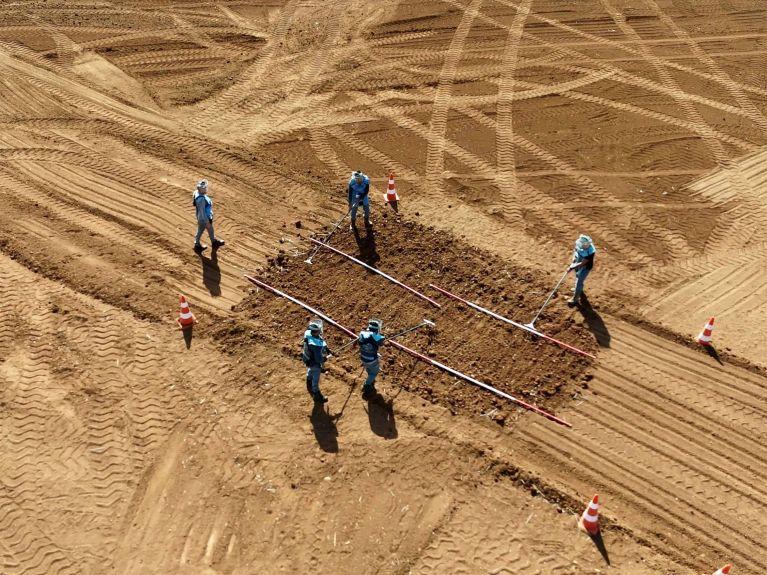
Life among unexploded ordnance
Whether in villages, on farmland or in school buildings: mines lurk almost everywhere in Syria. The HALO Trust removes them – with support from Germany.
 Kim Berg
 For several years the primary school in Khan Shaykhun stood empty. The town in the north-west Syrian province of Idlib became tragically well known during the civil war after a chemical weapons attack in 2017. The city was fought over for a long time and many buildings remain destroyed to this day. The walls of the primary school are riddled with bullet holes, too. For years the buildings could not be used because unexploded ordnance from the conflict remained on the site. But now children run across the playground, play football and chat about their favourite subjects. Teaching has been going on here again since autumn 2025 – after the humanitarian mine-clearance organisation HALO Trust cleared the area of explosive devices.
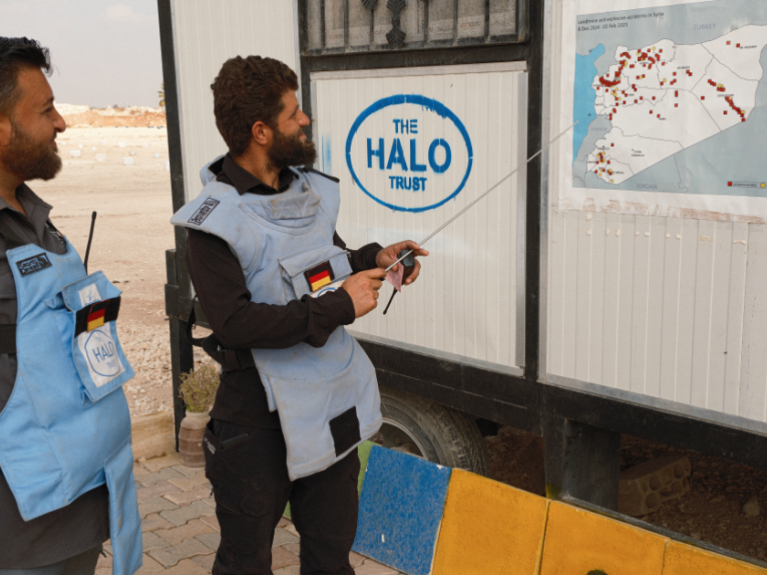
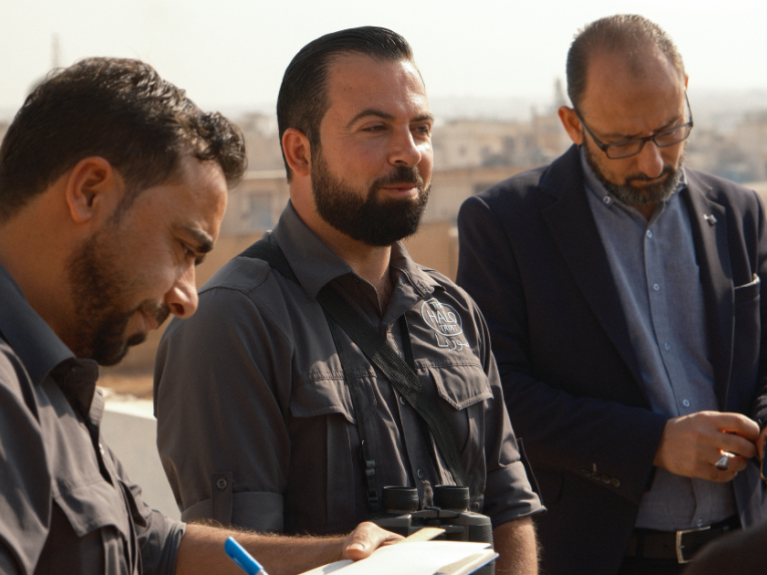
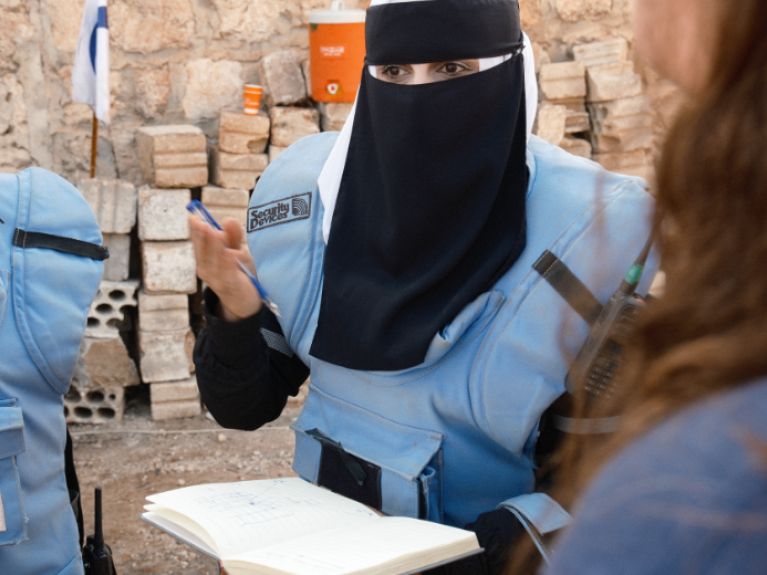
Since 2017 the NGO has been clearing mines and unexploded ordnance in Syria, educating the local population and mapping minefields. Founded in 1988 in Afghanistan, it is now active in more than 30 countries and territories in Africa, Asia, Europe and the Caucasus, Latin America and the Middle East. “Before the fall of Assad we had only one office in the north-west of the country; now we have several offices across Syria – including in Aleppo, Deir ez-Zor, Daraa and soon in Homs and Damascus,” says Farouk al-Mustafa, Operations Officer at HALO Trust. 40 staff were responsible for mine clearance and awareness work in the region at that time; by November 2025 the team had grown to more than 200 people. The organisation recruited its additional staff from the local population. After training, they gradually took over the duties of their international colleagues. HALO Trust has already cleared more than 330,000 square metres of land in Syria of explosive remnants.
Support for this comes from Germany. “Germany is making a significant contribution to promoting stability in Syria by co-financing mine clearance,” says al-Mustafa. In 2025 the Federal Foreign Office is supporting HALO Trust’s work in Syria with around five million euros. With a total of 70 million euros, Germany is one of the world’s largest donors for clearing mines and explosive ordnance in former and current conflict regions. To this end, the Federal Foreign Office works mainly with organisations that operate in the affected regions.
Germany’s involvement in mine clearance is based fundamentally on the Ottawa Convention – a legally binding international agreement concluded in 1997 that bans the use, production and transfer of anti-personnel mines. By ratifying it, the Federal Republic committed not only to dismantling its own stockpiles in full but also to supporting affected states in addressing the humanitarian consequences of mines and explosive remnants.
Mines and unexploded ordnance are obstructing reconstruction
“The scale of contamination with explosive devices in Syria is enormous,” says al-Mustafa. The Syrian province of Idlib is particularly badly affected. From 2017 onwards the region was under the control of the jihadist HTS militia and remained the largest rebel stronghold against Assad until the end. Because of the shifting front lines during the war, other rural areas of Syria are also contaminated with mines and explosive remnants – with serious consequences for everyday life. Once regarded as Syria’s breadbasket because of its fertile soil, Idlib has since lost much of that reputation.
Many people are still living in tents or have returned to badly damaged homes. Numerous schools remain closed because explosive remnants of war pose an acute danger. Farmers are reluctant to cultivate their land because mine accidents continue to occur. According to HALO Trust, 585 people have been killed by mines and unexploded ordnance since Assad’s fall on 8 December 2024, including 165 children. More than 1,000 others have been injured (as of November 2025). But the actual number is likely to be much higher, since there is no central database for such accidents and no coordinating authority. “Since the fall of Assad we’ve been seeing more and more incidents involving explosive remnants,” says Seba Abdulkareen, Survey Supervisor at HALO Trust. Newly gained freedom of movement and the return of displaced families increase the risk of injuries from war remnants. More than 1.25 million people have returned to Syria since December 2024.
Education saves lives
HALO Trust in Syria receives several reports every day of explosive artillery or minefields being discovered. “When we receive information, our teams first gain an overview of the situation. They ask local people about possible finds, document remnants and examine locations,” Abdulkareem explains. If there is solid evidence of a minefield, HALO Trust begins locating and then clearing it.
For large-area clearance operations in Syria, the organisation uses front loaders: these are tractors with special digging buckets that lift mines and explosive devices out of the earth and sift them. Six of them are currently clearing a roughly 300,000-square-metre minefield along what used to be the front line between HTS and the Assad regime’s troops. Almost 50 explosive devices have been removed from the site to date. The organisation also removes individual explosive remnants. If they are located in an uninhabited area, they are often detonated in a controlled manner to avoid transporting unstable devices.
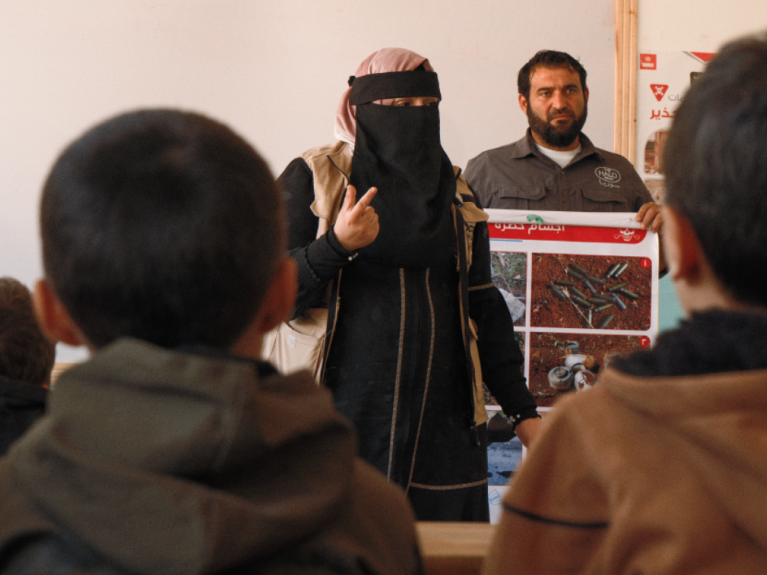
Alongside mine clearance, HALO Trust also actively pursues educational activities to reduce risks for the population. “We offer awareness courses in schools, villages and residential neighbourhoods,” says al-Mustafa. The primary school in Khan Shaykhun is one of the places where the organisation also provides awareness training. HALO Trust has reached more than 708,000 people this way.


