“Is it possible to have children in space?”
Questions like these about the female body in zero gravity are what drive 19-year-old Cosma Heckel. Her dream is to become an astronaut – and she is already in contact with NASA.
Cosma, where are you speaking to me from?
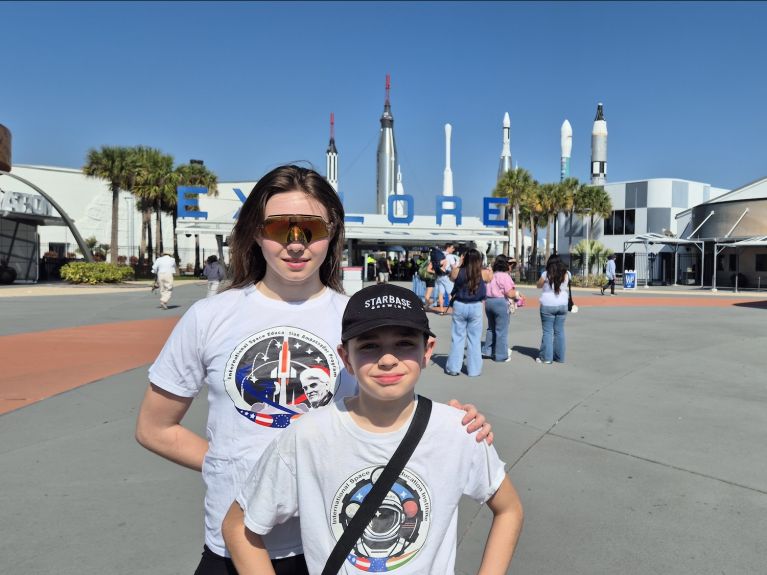
I’m currently in the US to watch the launch of the Artemis-2 moon mission. I previously watched Artemis 1 live in 2022, including several aborted launch attempts. That’s why it’s so special for me to see the continuation now – this time not unmanned, but with four astronauts on board.
How did you get into space travel?
In a way, I was born into it. My father runs the non-profit education centre International Space Education Institute (ISEI) in Leipzig. That meant I travelled and was involved in projects from a very young age.
You’ve already gained quite a lot of experience in space exploration – including with NASA ...
Yes, I took part early on in the Rover Challenge, an international NASA competition where you build a moon rover and drive it over a course. Overall, we’ve won the world championship title at the Rover Challenge three times, most recently in 2019. I’ve also attended Space Camp in the US and other summer camps. That gave me insights early on into what is possible and that even big dreams that initially sound unrealistic can be achieved.
There are so many unanswered questions about planets, about non-human life – but also about how the human body changes in space, for example.
You want to become an astronaut. Why?
What fascinates me most is how much is still unexplored. I have an enormous desire to search for answers. To me it’s a challenge. There are so many unanswered questions about planets, about non-human life – but also about how the human body changes in space, for example.
What do you mean by that?
In addition to space travel, I’m interested in biology. And I ask myself: what do women in space, on the ISS for example, actually do when they have their period? And is it possible to have children in space? In one research paper I wrote, I undertook a close study of the female body in zero gravity, having interviewed gynaecologists and female astronauts. There is still far too little known – and that’s what drives me.


