German companies’ preferred investment locations in Southeast Asia
From Singapore to Vietnam: find out why German companies have been increasingly investing in ASEAN states and which countries are particularly attractive in this context.
 Françoise Hauser
 Pharmaceutical sector, automotive industry and mechanical engineering: when it comes to investment abroad, German enterprises have been increasingly focussing on the ASEAN states. But what are the reasons for this development? And which countries and industries are the most popular?
“The ASEAN countries are enormously diverse,” says Alexander Hirschle, Director of the Germany Trade & Invest (GTAI) ASEAN Hub in Singapore. The federal business development agency has been operating its own hub in Singapore since 2024, aiming to report about business trends in the region and inform German companies about new business opportunities in Southeast Asia. There are many countries to choose from: Brunei, Indonesia, Cambodia, Laos, Malaysia, Myanmar, the Philippines, Singapore, Thailand and Vietnam are all members of the ASEAN business association, whose latest addition is Timor-Leste.
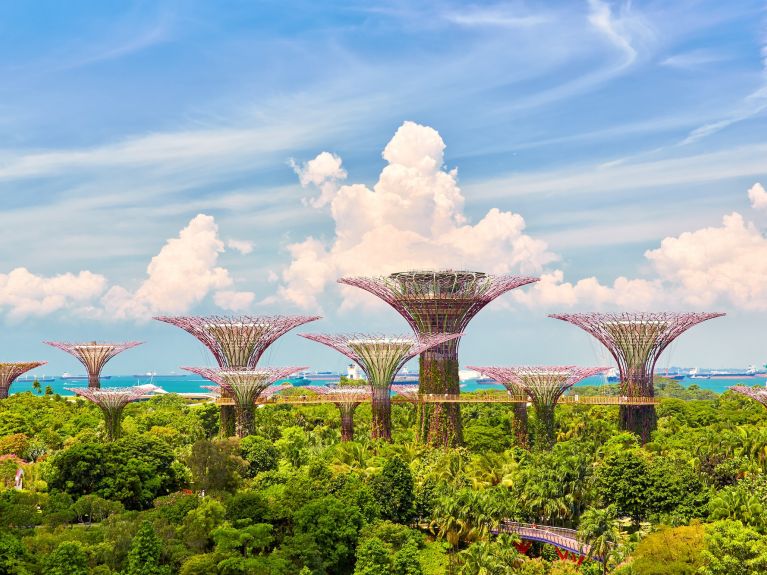
Its political and legal stability make Singapore a reliable choice.
Some 334 million euros were invested in Singapore in 2023, a share of about twelve percent of German foreign investment in Southeast Asia (around 2.8 billion euros in 2023). “Political and legal stability and high education standards make the city state a reliable and most importantly a predictable choice,” Mr Hirschle points out. “Many companies operate their regional hubs here or choose Singapore as a starting point for entering the region. This is where the GTAI Hub comes in, whose purpose is to help German enterprises find a suitable market.”
Booming high-tech industry
Alexander Hirschle continues by saying that there is great interest in investing in other ASEAN countries, too. Thailand and Malaysia are traditional production locations of German industry and in particular of the automotive, chemical and mechanical engineering sectors. The high-tech sector in Malaysia received an additional boost in early 2025. This was due to the newly created special economic zone in the Johor border region that includes Singapore but is four times the size of the city state.
One of the key advantages of the ASEAN region is the vast diversity of specialisations. In the Philippines, German investors appreciate the strong service orientation and the fact that English is one of the official languages. “Many call centres and services providers from areas such as finance and accounting are based here,” Mr Hirschle states.
Indonesia, on the other hand, as the region’s most populous country, accounts for over 36 percent of GDP and is characterised by its large internal market with more than 280 million people, as well as close proximity to raw materials such as nickel and plans to take up rare earth extraction. Armin Heider, Head of the International Division of the Bonn/Rhein-Sieg Chamber of Industry and Commerce, explains that the country also features a growing market for machinery and consumer goods.
“Around 300 to 400 companies are already represented in Indonesia,” Mr Heider says. These include some big players such as the Siemens Group that has invested into turbine manufacturing in Bandung on the Indonesian island of Java. Another example is the Bosch Group that built the world’s first modular automotive components factory near Jakarta in 2025. The free trade agreement concluded between the EU and Indonesia is expected to provide further positive momentum over the next few years. “Around 80 percent of all customs duties are to be eliminated as soon as 2027,” Mr Heider states.
Vietnam has a young population and the country’s government is committed to promoting education.
Alexander Hirschle highlights Vietnam as being the next Asian Tiger. Gudrun Grosse, Head of the International Division of the Cologne Chamber of Industry and Commerce, also confirms that the country, that is shaped by Confucianism, has a young population and a government that is dedicated to promoting education. A free trade agreement between Vietnam and the EU has been in place since 2020. “Compared to other countries in the region, labour costs are relatively low in Vietnam and workers are very skilled,” Ms Grosse says.
Labour-intensive production steps play a central role in Vietnam, especially in the textile industry, but also in the chemical, automotive, pharmaceuticals and electronics industries. Bosch is among the key investors, operating a large production facility for pushbelts (a key technology for modern drive systems) in Dong Nai, as well as research and development centres.
STADA Pymepharco produces medicinal products in Phu Yen. About half of the investment projects are from general service providers in fields such as consultation, logistics and partial international relocation of production activities. The number of industrial high-tech projects is also on the rise.
Supplementing China
Apart from the respective advantages of each location, there is another key factor for many companies: they are looking for alternatives to China. Those who are looking to establish a broader base for their activities in Asia have been increasingly relying on a “China+1” approach.
“If companies are investing outside China, Vietnam tends to be the only suitable addition,” Gudrun Grosse says. Alexander Hirschle, too, refers to geopolitcal considerations. He stresses that Southeast Asia would remain accessible to companies, even in the event of the China-Taiwan conflict escalating.
Investment in ASEAN countries can be very worthwhile for German companies. However, the local societies also benefit from the presence of German investors: “German companies tend to rely on a long-term approach and to strongly promote education and training. They usually establish their own qualification programmes for their local workers,” Grosse points out, adding that this translates into good future prospects that contribute to making the region more attractive.


