
“High profitability, low risk”
Asian firms are increasing their investment activity in Germany. GTAI expert Achim Hartig explains why this also benefits the German economy.
 Françoise Hauser
 Asian firms have significantly increased their investment activity in Germany in recent years. For the most part, these are investors from China and India. It’s not only in these two huge countries that a lot is happening at the moment, however. At the federal economic development agency Germany Trade & Invest (GTAI), Achim Hartig is responsible for attracting investors to Germany. He explains in our interview which countries and sectors are particularly important - and how Germany can benefit.
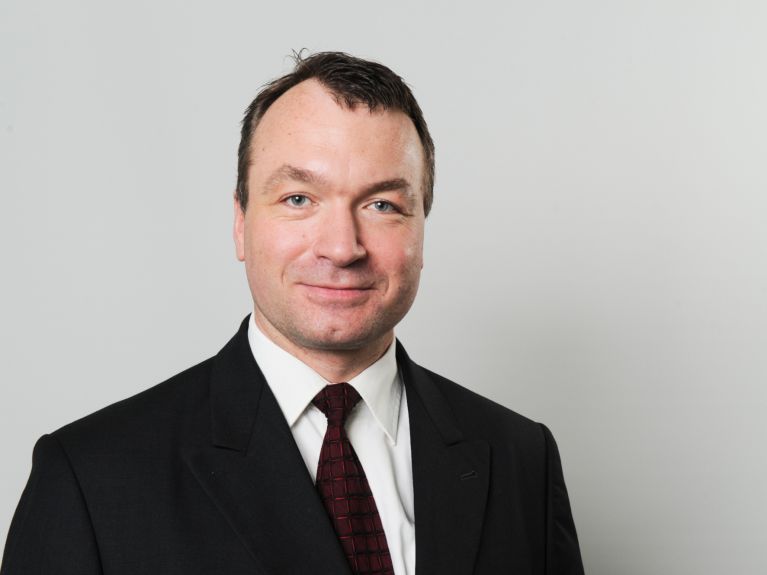
Mr Hartig, what role does investment from Asia play for the German economy?
It is above all countries that are similar to or complement Germany particularly well that are important and relevant. I’m talking especially about Japan here, though also about South Korea and Singapore, which account for a large proportion of so-called greenfield investments - investments in entirely new production facilities or branches. Investors from these countries have one thing in common: they generally invest in the technology sector. This makes sense for Germany because we try to attract investors who will plug gaps in value chains - such as in battery production - and make the German economy more resilient in areas such as energy generation, transport and storage. At the same time, we also want to foster exchange between science and industry when it comes to investments from Asia. To this end, we talk to high-tech firms and attempt to persuade Asian companies to relocate their R&D to Germany. We do this particularly with firms from Japan.
What characterises investment from Japan?
In 2025, Japan was the second-biggest investor in Germany after China, with 81 projects compared to China’s 186. Japan and Germany share high quality standards, and both countries have an economic structure characterised by small and medium-sized enterprises (SMEs). In Germany, a particularly important role is played by the automotive and mechanical engineering sectors, robotics and medical technology, as well as by electric vehicles and digital technologies. The gaming industry is likewise of interest to us. This is not for entertainment reasons, however, but for visualising and simulating new technological developments.
Germany is committed to free market principles and has a reliable legal system.
Which other Asian countries are important?
South Korea definitely deserves a mention - it was involved in no fewer than 29 projects in Germany in 2025. SMEs play an important part in the economy there too, though the economy is structured differently, with SMEs acting as suppliers to the chaebols - South Korea’s major conglomerates. Electric vehicles, semiconductor technology, electronics and gaming are also the main focus of South Korean investments. 24 firms fromSingapore, where GTAI has been represented by its own GTAI Hub since 2025, have likewise invested in Germany, especially in the fintech sector. VIRTUS Data Centres, which has invested around three billion euros in a data centre in Brandenburg, warrants a particular mention in this context. When it comes to semiconductor technologies, Malaysia is also worth mentioning with three companies active in this field, as is Taiwan: Taiwan Semiconductors has invested ten billion euros in Dresden. Last but not least, Vietnam is also evolving to become a promising investor. High tech is gaining momentum in the Southeast Asian country, and Germany is keen to play a first-mover role there.
What attracts Asian investors to Germany?
“High profitability but low risk” would be one way to sum it up. Germany is committed to free market principles and has a reliable legal system that protects investors and intellectual property rights. What is more, Germany is the largest market in Europe, which in turn is considered the world’s largest market. With 3.5 million SMEs, Germany boasts a huge number of customers, suppliers and indeed competitors - creating a thriving environment of partnership and competition.


