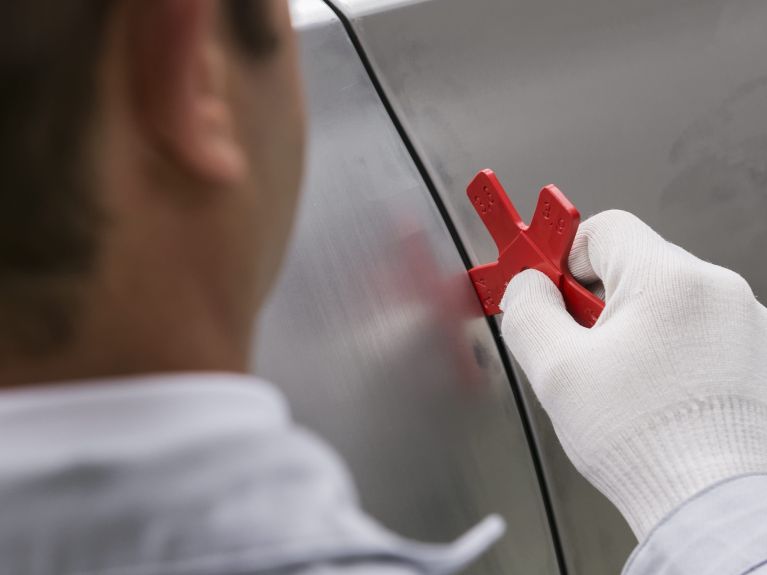
German precision: a cliché that’s true
From workbench to microchip: German precision isn’t a myth, it’s a principle - and one that has evolved historically, proven its technical worth and is still practised to this day.
 Wolf Zinn
 Clichés can quickly land you in a quagmire of exaggeration and hyperbole - when talking about Germans, for instance. However, there is one cliché that does hold true, in the very best sense: Germans are commonly said to be highly efficient and precise. This might provoke a smile at first, but a closer look reveals a widespread tendency to embrace a particular cultural technique: Germans have a penchant for tinkering, engineering and precision, as well as for processes and machines that don’t just work occasionally but function reliably and permanently.
One excellent example is a standard sheet of paper. The fact that formats such as A4 have become established worldwide is testimony to a mindset that regards standards as a means of taming complexity. Standardisation may not be a solely German invention - but Germany institutionalised it. In the world of technology, it ultimately speeds things up - despite all the bureaucracy: be it screws, threads, plug-in connectors or test protocols – wherever people work or manufacture things, standardisation saves time, money and stress. Efficiency is achieved by a perfect fit.
From the art of measurement to a high-precision machine
Precision begins with a measurement. When it comes to everything from cars, aircraft and microscopes torobots, tools, laboratory standards and quality management, the success of German technology and innovation often has been and remains rooted less in a brilliant flash of inspiration than in a consistent process of gradual improvement. Historically, this is evidenced not only by the development of various high-quality products made in Germany, but also by the training provided at the country’s universities and companies – not to mention by numerous pioneering individuals: from the car inventor Carl Benz and computer pioneer Konrad Zuse or the physicist Maria Goeppert-Mayer to contemporary innovators such as the robotics founder David Reger, the engineering expert Sabine Kunst, the entrepreneur Ralf Bux, the physicist Lisa Haas, the electrical engineer Thomas Wiegand and many more besides.
Dieses YouTube-Video kann in einem neuen Tab abgespielt werden
YouTube öffnenThird party content
We use YouTube to embed content that may collect data about your activity. Please review the details and accept the service to see this content.
Open consent formIt’s not about showing off - it’s about quietly delivering a quality product
Many German companies are hidden champions that dominate in niche areas because they build machines that run for many years with minimal downtime. In the automotive industry, extremely exact German clearances - that is to say the gap between two adjacent components - have become something of a running joke because they epitomise something that an amateur will never see: the discipline of precision manufacturing.
And then there’s the German penchant for safety: a process must be exactly right and reproducible before it qualifies for Germany’s notoriously rigorous certification. Though this may seem pedantic, such precise stipulations in fields such as medicine, chemistry, food, energy and mobility have already saved many lives.


