Can climate summits change the world?
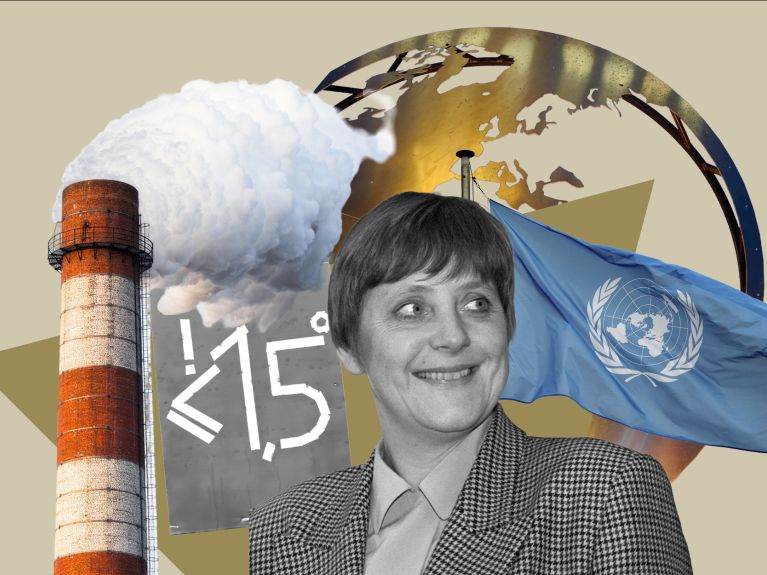
From the Kyoto Protocol and Paris Agreement to the Loss and Damage Fund: UN Climate Conference milestones and Germany’s role.
 Kim Berg
1995: The first climate summit is launched in Berlin
The first COP took place in Berlin in 1995. The states that assembled there adopted the Berlin Mandate: they tasked a working group with negotiating a more effective international climate protection instrument by 1997.
1997/2005: The Kyoto Protocol is the first legally binding international climate agreement
The Kyoto Protocol was adopted at COP3 in Japan in 1997 and entered into force in 2005. For the first time, industrialised countries undertook binding commitments to reduce their emissions by five percent below 1990 levels between 2008 and 2012.
Under the EU’s internal burden-sharing agreement, Germany committed to reducing its greenhouse gas emissions by 21 percent - and actually succeeded in lowering them by 23.6 percent.
2015: The Paris Agreement makes climate action everyone’s responsibility
At COP21, 195 signatories adopted the Paris Agreement. The goal was to keep global warming well below two degrees Celsius above pre-industrial levels and to do everything possible to cap the increase at 1.5 degrees.
The EU made a legally binding commitment to achieve climate neutrality by 2050. Germany has gone one step further: it wants to reach greenhouse gas neutrality by 2045.
Dieses YouTube-Video kann in einem neuen Tab abgespielt werden
YouTube öffnenThird party content
We use YouTube to embed content that may collect data about your activity. Please review the details and accept the service to see this content.
Open consent form2022/2023: A fund for climate impact damage is established
At COP27 in Egypt, the signatories decided in 2022 to establish a “Loss and Damage” fund. The idea was for it to support developing countries that are particularly badly hit by climate-related damage and losses.
At COP28 in Dubai, Germany and the United Arab Emirates each pledged to contribute 100 million US dollars to the fund. In total, the participating states pledged around 700 million US dollars at COP28.

Dieses YouTube-Video kann in einem neuen Tab abgespielt werden
YouTube öffnenThird party content
We use YouTube to embed content that may collect data about your activity. Please review the details and accept the service to see this content.
Open consent form2023: Nations agree to transition away from fossil fuels
Parties at COP28 adopted the first global stocktake under the Paris Agreement. They agreed for the first time to transition away from fossil fuels in a just, orderly and equitable manner. In addition, an undertaking was made to triple worldwide renewable energy capacity by 2030.
Germany had already enshrined the phaseout of coal in law three years earlier: the coal exit law, which came into force in 2020, stipulates that the last coal-fired power station must close down by the end of 2038 at the latest. By 2030, renewable energies are to meet 80 percent of the country’s gross power consumption.
2026: Negotiations continue at COP31 in Antalya
From 9 to 20 November 2026, delegations from across the world will be meeting at COP31 in the Turkish city of Antalya. Turkey is the host and holds the COP presidency, while Australia will chair the negotiations. The main focus will be on climate funding for small island nations and the Pacific Resilience Facility, the first fund for tackling climate change impacts that is being managed by Pacific island states themselves.

