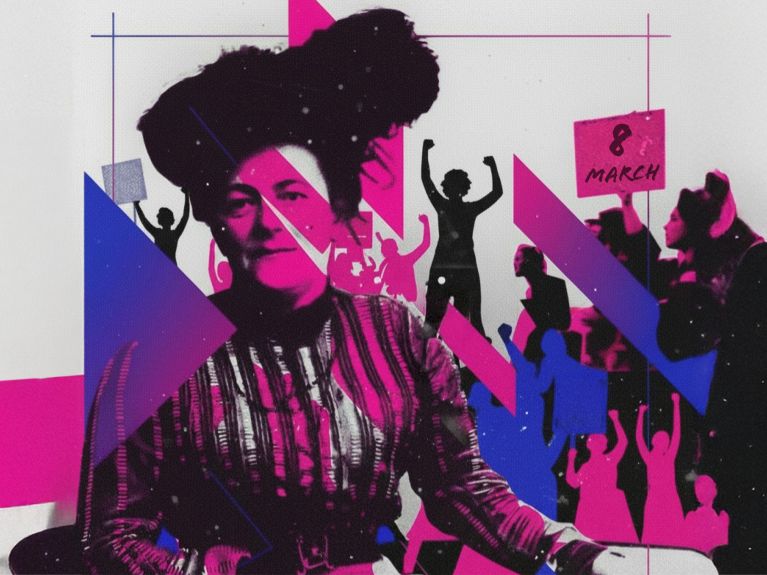
From Zetkin’s idea to International Women’s Day
What began as a demonstration for female suffrage is today an international day of action for gender equality. The eighth of March symbolises historic struggles and topical debates.
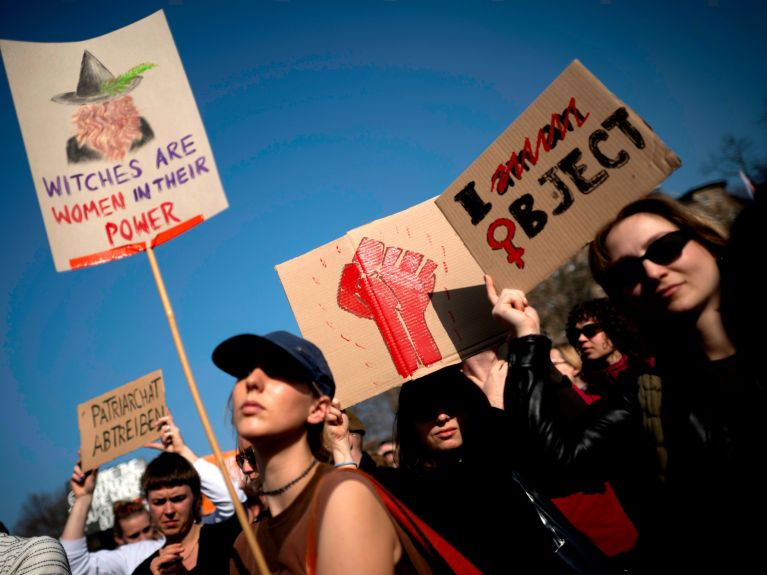
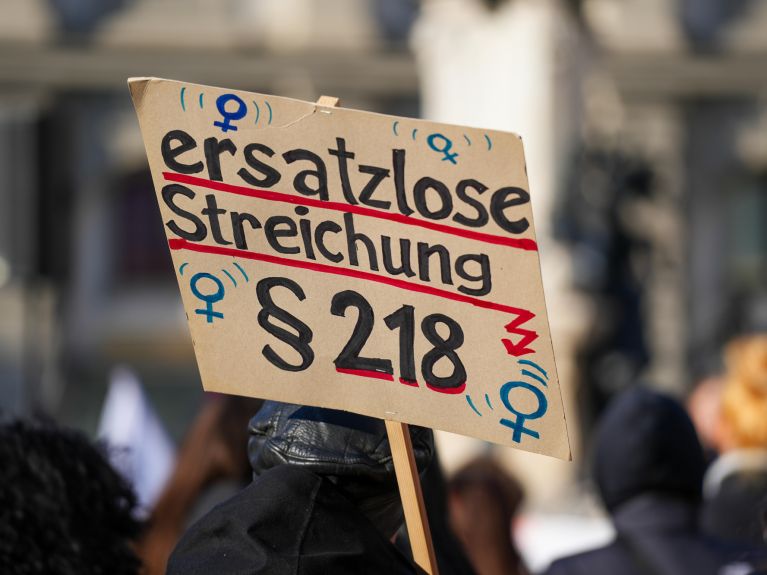
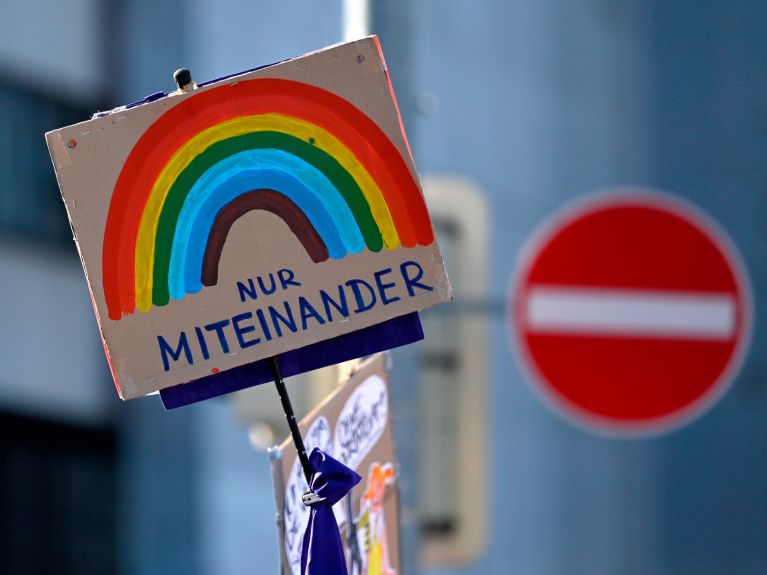
The eighth of March sees women and men alike take to the streets in many cities around the world to demonstrate for the right of women to self-determination. Conferences are held to highlight the importance of gender equality, while many companies present flowers to their female staff. These days, International Women’s Day is a day of action celebrated worldwide. In Germany, it has been an official public holiday in Berlin since 2019 and in the state of Mecklenburg-Western Pomerania since 2023.
1. How did International Women’s Day come about and why is it celebrated on 8 March?
International Women’s Day has its roots in the socialist female workers’ movement of the early twentieth century. In 1909, women in the USA organised a day of protest for female suffrage. At a women’s conference in Copenhagen a year later, German socialist Clara Zetkin proposed an annual day of action. It was celebrated in several European countries for the first time in 1911.
When female workers went on strike in the Russian city of Petrograd on 8 March 1917 to demand bread, peace and political reforms, this date was adopted as International Women’s Day in many countries. In 1977, the United Nations called on its member states to introduce an international day for women’s rights.
2. What role did the women’s movement play in bringing about female suffrage in Germany?
From the late 19th century, middle-class and socialist women’s associations alike in Germany began calling for women to be granted the right to vote. When International Women’s Day was introduced in 1911, their demands were given an international platform. The day of action helped make female suffrage a publicly visible political issue, thereby increasing the pressure on the government.
Female suffrage was only granted following the November Revolution in 1918. On 12 November, the Council of People’s Deputies proclaimed equal and general suffrage for all men and women aged 20 and over. When the constitutional National Assembly was elected on 19 January 1919, 37 of its members were women.
3. How have women’s rights evolved in Germany since 1945?
Following the Second World War, both German states, the Federal Republic of Germany and the German Democratic Republic (GDR), enshrined gender equality in their constitutions in 1949. Women’s employment was politically desirable and widespread in the GDR, though it frequently resulted in a double burden of work and family duties.
Despite the principle of gender equality enshrined in the Basic Law, women in the Federal Republic - West Germany - initially remained at a legal disadvantage. Until 1958, a husband could terminate his wife’s employment under certain circumstances. It was only when marriage and family law was reformed in 1977 that equality in marriage was made legally binding.
The equality mandate in the Basic Law was strengthened in 1994. Reforms covered, among other things, protection against domestic and sexualised violence, the reconciliation of family and working life and binding quotas aimed at increasing the number of women in leadership positions.
4. Where does inequality still exist between women and men in Germany?
The adjusted gender pay gap shows that women in Germany still earn on average six percent less than menin comparable positions. They perform a large part of unpaid care work, work part-time more often and thus receive a smaller pension on retirement. They are still more rarely to be found occupying leadership positions. In the 40 largest publicly traded companies, only around one quarter of board members are women. Women account for roughly one third of parliamentarians in the Bundestag. It is also primarily women who are at risk of domestic violence.
5. What role does Germany play when it comes to the international protection of women’s rights?
The international protection of women’s rights is based on several treaties. These include the 1979 UN Convention on the Elimination of all Forms of Discrimination against Women (CEDAW), the 2011 Istanbul Convention of the Council of Europe and UN Resolution 1325 on Women, Peace and Security from the year 2000. They require states to better protect women and report regularly on their progress.
Germany supports and implements these treaties. CEDAW has been in force in Germany since 1985, while the Istanbul Convention has been applied without restrictions since 2023. Furthermore, the Federal Government supports international projects aimed at promoting women’s rights and is involved in the organisation UN Women. Germany also regularly raises the subject of women’s rights in international forums such as the EU, the G7 and the G20.


