Pro & Contra
Banning the AfD: what are the arguments for and against?
Should proceedings to ban the AfD be initiated? Historian Norbert Frei and former President of the Federal Constitutional Court Hans-Jürgen Papier take opposing views.
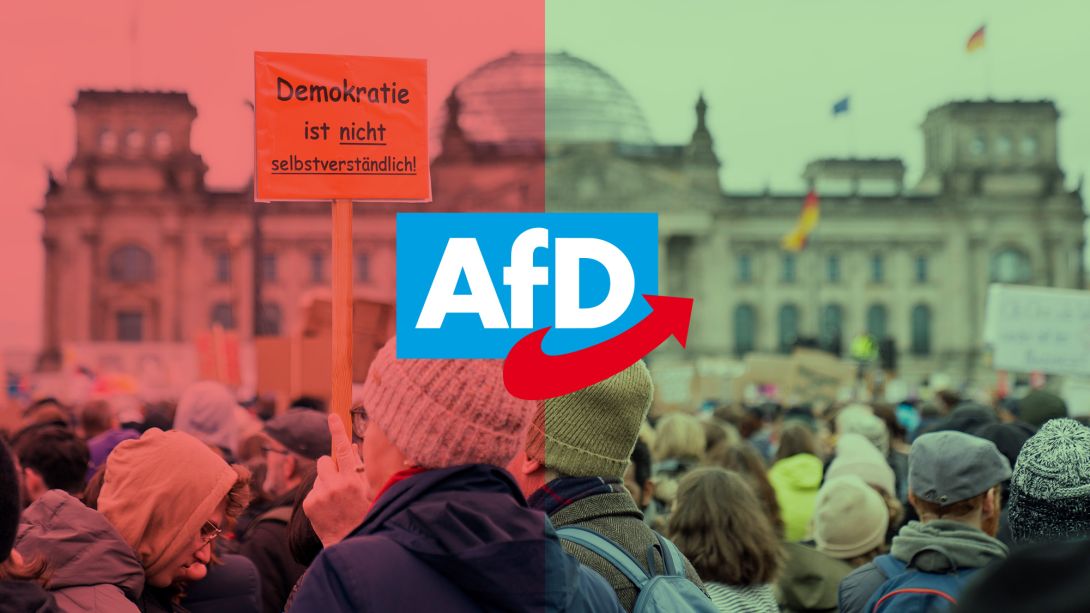

Pro
Historian Norbert Frei was Professor of Modern and Contemporary History at Friedrich Schiller University Jena. His biography of Adenauer, “Kanzler nach der Katastrophe”, was published in 2026.

Contra
Constitutional law scholar Hans-Jürgen Papier was President of the Federal Constitutional Court (2002–2010). His book “Unantastbar: Warum ein starkes Bundesverfassungsgericht über die Zukunft von Demokratie und Freiheit entscheidet” was published in 2026.
Mr Frei, Mr Papier, the AfD received 43.8 per cent of the vote in the state election in Saxony-Anhalt. What does an election result like this mean in terms of the debate about possible proceedings to ban the party?
Norbert Frei: Frankly, I find it difficult to understand why the issue still needs to be examined “carefully, professionally and seriously” by a federal-state working group. There has been ample time to do that over the years. After all, five AfD state associations have been classified as “confirmed right-wing extremist” by the respective domestic intelligence agencies. The indecision of the democratic parties in the face of the declared enemies of the Weimar Republic should serve as a lesson to us. Just as it did for the fathers and mothers of our constitution, who drew lessons from the failure of Germany’s first democracy, which they had witnessed and in some cases helped bring about. They ensured that the Basic Law contained safeguards designed to prevent democracy from abolishing itself.
Hans-Jürgen Papier: I see it differently. Banning a political party is fundamentally an undemocratic measure carried out with the intention of protecting democracy. As a measure of last resort, proceedings should only be initiated if the very strict requirements are met. As far as the AfD is concerned, I consider calls for proceedings to ban the party to be legally unfounded and politically extremely unwise. They would only strengthen the party and further polarise society.
Is there sufficient evidence to apply for a ban?
Frei: Of course, I’m not familiar with all the information about the AfD available to the Federal Office for the Protection of the Constitution, nor do I have detailed knowledge of the basis on which the domestic intelligence agencies in the states in question classified the respective AfD state associations as “confirmed right-wing extremist”. But I have closely followed the development of the AfD in Thuringia under its leader Björn Höcke for years, and I firmly believe that, if not at federal level, then at least there an application for a ban under Article 21(2) of the Basic Law is urgently called for. Whether a party is ultimately banned is of course a matter for the Federal Constitutional Court in Karlsruhe to decide. But in my view there are plenty of reasons to apply for a ban.
Papier: What matters is what evidence there is. It would have to be possible to demonstrate that the AfD as a whole has a strategic plan to implement the concept of “ethnic and cultural national identity”, for example, and in doing so intends to violate the Basic Law’s guarantee of human dignity for certain groups of people. Evidence of numerous statements reflecting an ethnic concept of national identity based on ancestry would not be sufficient, nor would expressions of anti-foreigner or anti-migration views. The party would have to work systematically and continuously towards achieving an anti-constitutional political objective through concrete preparatory actions. Based on the publicly available information, there is no verifiable evidence of this.
Can a party that is elected by millions of people be banned?
Frei: It is often said that proceedings to ban the AfD would amount to trying to “ban away” its voters. My response – one increasingly shared by people concerned about the future of democracy in Germany – is this: if there are compelling grounds for proceedings to ban the party, then, in keeping with the spirit of our Basic Law and the principle of a “democracy capable of defending itself”, such proceedings must be initiated. If the court in Karlsruhe does impose a ban, those who are still voting for the AfD by then will have to reconsider their position – and hopefully change their minds.
Papier: A party ban would certainly have far-reaching consequences: it would mean that a very substantial proportion of eligible voters would effectively lose their right to vote. What is more, elected representatives would have to leave parliament, because a party ban would cause them to lose their seats. This would result in what might be called “rump parliaments”, undermining the legitimacy of the parliaments as a whole and calling parliamentary democracy itself into question. Legally, however, the size of a party does not preclude it from being banned. For a political party to be banned, its size and influence must be sufficient for it to be capable of abolishing or undermining the free democratic basic order. Under the case law of the Federal Constitutional Court, there is therefore a further requirement: that of potentiality. The larger and more successful a party is, the greater its potentiality, so this aspect would certainly not stand in the way of a ban – quite apart from the question of whether the party is unconstitutional or not.
What would the effect be of simply initiating proceedings to ban the party?
Frei: I would expect this to send out a signal long before the Federal Constitutional Court reaches a decision, which would inevitably take time. Not initiating proceedings carries the risk that the AfD’s current growth in support will increase further. Not least because it would implicitly confirm what far too many people in Germany already think: that the AfD is a “completely normal” party, only more attractive than all the others in their eyes.
Papier: In my view, initiating proceedings before the Federal Constitutional Court to ban the party would be extremely risky and could enhance the party’s standing in the eyes of large sections of the population, both in the media and in moral terms. For this reason, I see an ultimately unsuccessful attempt to ban the party as posing the greater danger to the institution of parliamentary democracy.
How do proceedings to ban a political party work?
Only the Federal Constitutional Court can ban a political party. An application can be submitted by the Bundestag, Bundesrat or Federal Government. Anti-constitutional views alone are not sufficient for a ban. A party must actively seek to undermine or abolish the free democratic basic order. There must also be concrete indications that it could succeed in achieving its anti-constitutional objectives. If a party is banned, it is dissolved; the formation of substitute organisations is also prohibited. The possibility of banning political parties stems from Germany’s historical experience of the collapse of the Weimar Republic (1919–1933) and the subsequent period of National Socialism. The National Socialists used democratic mechanisms – such as freedom of expression and free elections – to undermine and abolish democracy from within. In the history of the Federal Republic of Germany, the Federal Constitutional Court has banned political parties in two cases: the National Socialist-oriented Socialist Reich Party (SRP) in 1952 and the Stalinist Communist Party of Germany (KPD) in 1956.