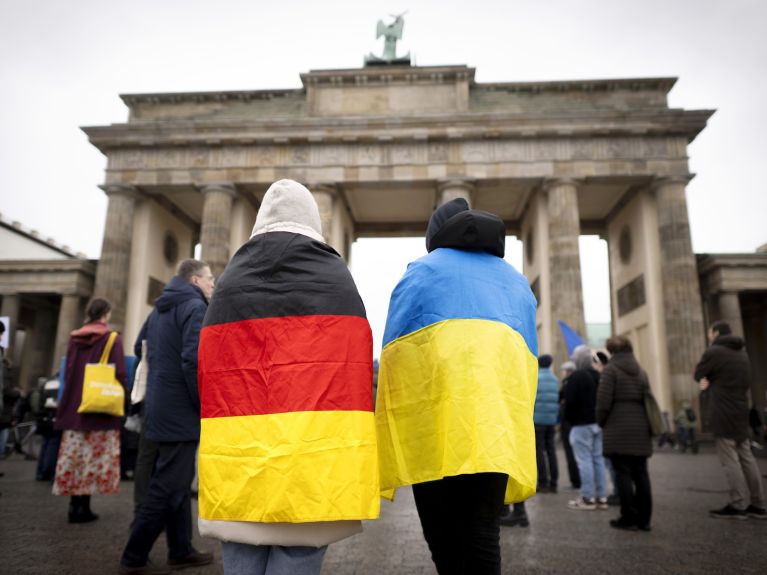
“We are there for each other”
The German-Ukrainian network of twinned cities is growing - all the more so since Russia began its war of aggression.
 Johannes Göbel
 It doesn’t always have to be about making major political decisions at the global level: “Even relatively small projects can convey to the people in Ukraine that we are there for each other.” This is what Oleksii Makeiev, Ukraine’s ambassador to Germany, stressed at the “7th German-Ukrainian Municipal Partnership Conference” in Münster in September 2025. The mere fact that these conferences are held so regularly - the next will be staged in Berlin in October 2026 - is proof that a lot is happening in terms of German-Ukrainian city twinning programmes just now.
Wide-ranging German-Ukrainian network
Since 2015, a service agency working on behalf of Germany’s Federal Ministry for Economic Cooperation and Development (BMZ) has been supporting a network that now encompasses 250 municipal partnerships. Ever since Russia began attacking Ukraine in February 2022, numerous German towns and cities have contacted the service agency because they want to help municipalities in Ukraine. Within the network, the partners in both countries support one another in areas such as energy efficiency, sustainable urban development and good local governance. Furthermore, several new twinning agreements have recently been concluded between major German and Ukrainian cities.
Kiel and Kherson, Heidelberg and Odesa
In 2024, for example, the cities ofKiel and Kherson entered into a new partnership, as did Frankfurt am Main and Lviv. Odesa, a major Ukrainian city on the Black Sea that already had cooperative agreements with several German cities, launched a new twin city agreement with Heidelberg in 2025. Since the start of the war, Heidelberg has supported Odesa by donating fire brigade and refuse collection vehicles and inviting Ukrainian orphans to take part in a programme of leisure and recreation activities in Heidelberg. Countless of these “small projects” referred to by the Ukrainian ambassador are strengthening the ties between Germany and Ukraine - and in some cases envisioning a brighter future: for example, Berlin is helping its Ukrainian twin city of Kyiv set up a new tourism agency ready to welcome visitors once the war is over.


