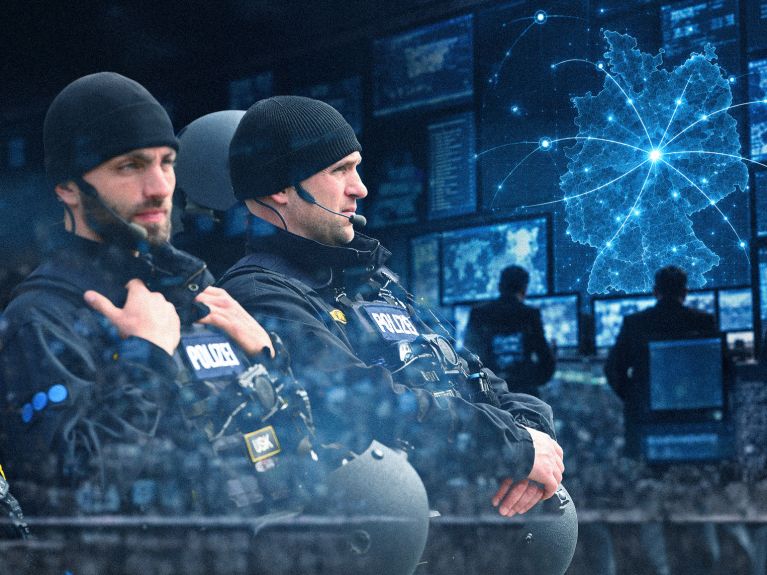
“Our response to the September 11 attacks”
The Joint Counter-Terrorism Centre was established in response to the 9/11 attacks. Marc Hallensleben from the Federal Criminal Police Office talks about prevented attacks and online jihadism.
 Interview: Helen Sibum
 Mr Hallensleben, what are the lessons in the area of counter-terrorism that Germany has learned from the September 11 attacks?
September 11, 2001 marked a turning point for security agencies around the world. Never before had there been an attack on this scale that was carried out by a foreign terrorist organisation. Later on, it turned out that there had been warning signs. Some of these were processed by the CIA, some by the FBI, and others by local police stations. The problem was that the findings were not combined. In Germany, too, there was a network that went unnoticed, the so-called Hamburg cell. We have a special constellation here in Germany because of the separation rule that provides that police authorities and intelligence services must be isolated in terms of their competences and organisation. So we asked ourselves, what we can learn from 9/11 to improve our security architecture without breaking the separation rule. The main response to this was to establish the Joint Counter-Terrorism Centre (GTAZ) in 2004, which is dedicated to addressing Islamic-motivated terrorism and extremism. By now, there are further centres that deal with other phenomena.

What does the work of the GTAZ look like?
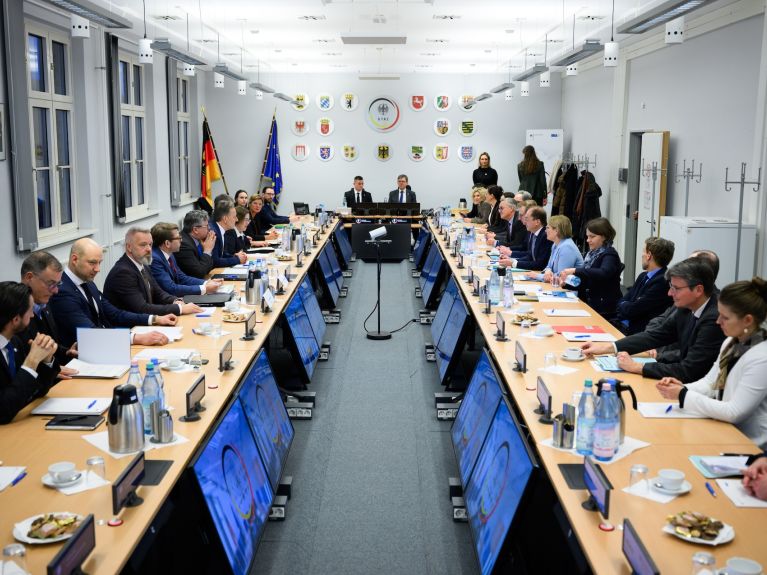
It is a joint communication and cooperation platform of 40 authorities: the state offices for protection of the constitution, the offices of criminal investigation of the 16 federal states, the Federal Criminal Police Office, the Federal Office for the Protection of the Constitution, the Federal Intelligence Service, and so on. Information is shared in the GTAZ in strict compliance with the legal separation rule that applies between the police and intelligence services, as well as in accordance with the respective data transmission regulations. The authorities involved work together in various formats that differ in their goals and structure. They have different tasks, such as analysis, prevention, averting dangers and law enforcement. This structure has proven to be successful.
If our work remains invisible, we have done a good job.
What does the track record of the GTAZ look like?
Were able to prevent close to 40 attacks in the 22 years since the GTAZ was established. In addition to this, there were many situations that were discussed in the GTAZ and that did not lead to any actual plans to carry out an attack, thanks to the measures taken. If our work remains invisible, we have done a good job. However, our track record also includes attacks that did happen and that we were unable to prevent, such as the one at the Christmas market on Berlin’s Breitscheidplatz in 2016. We have learned lessons from this, too, and have adjusted our activities accordingly.
What are currently the greatest challenges in fighting Islamic-motivated terrorism?
There are two aspects that stand out for me. On the one hand, the volatile motivation of offenders. In the past we were usually faced with a clear type: individuals with a strong ideological stance that had studied Islam intensively, even if they instrumentalised it for their own purposes. This has changed in recent years, in part due to online jihadism.
What is online jihadism?
The term refers to people being influenced in social media networks, where they are exposed to a worldview they adapt without really having a religious background. Instead, the basic motivation tends to be to serve their own extremist views or an affinity to violence. There are people who start out in the far-right milieu, then switch to the left-wing milieu before moving on to Islamism, where they find a particularly broad range of propaganda material that glorifies violence. For us, this means that we can no longer view the different phenomena in the area of politically motivated criminality as separate. The role of networking among the security authorities’ different centres will be gaining further importance.
What is the second great challenge?
The second big issue is artificial intelligence. It can be used as an instrument to commit crimes, and it can also promote radicalisation processes. At the same time it can help us fight terrorism, if we use it correctly.
Marc Hallensleben is the leader of the Department for Islamic-motivated Terrorism/Extremism at the Federal Criminal Police Office.
The separation rule is a lesson we learned from National Socialism. It aims to prevent an organisation, such as the secret state police Gestapo in the Nazi era, from ever forming again. The Gestapo was able to gather comprehensive information about people, to monitor them, carry out investigations against them and to randomly persecute them. The rule was established to prevent this type of power concentration. However, the separation rule does not mean that police authorities and intelligence services are banned from sharing any information with each other. What exactly is and isn’t allowed is provided for in data transmission regulations. The Federal Constitutional Court will decide in case of any doubt.


