What can the UN Human Rights Council actually achieve?
From 2027, Germany will once again be a member of this UN body that is tasked with protecting human rights worldwide - yet is reaching its limits. Reforms could change this.
 Friederike Bauer
What is the UN Human Rights Council and what is its role?
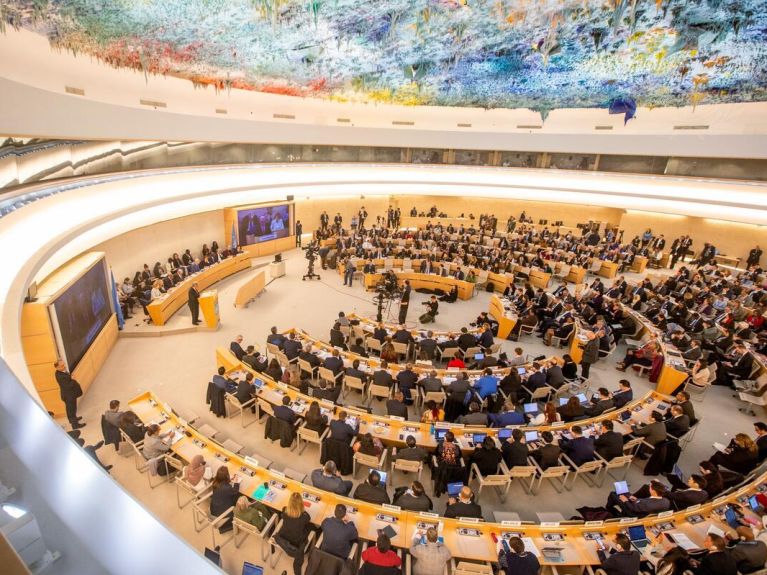
The Human Rights Council is an international United Nations body based in Geneva. Its primary function is to promote and protect human rights worldwide. It regularly reviews the human rights situation in all UN member states and recommends ways of improving it. It can also convene commissions of inquiry. This happened for example in Ukraine to document violations of basic rights in Russia’s illegal war of aggression, and in Iran to investigate the suppression of protests by force.
Dieses YouTube-Video kann in einem neuen Tab abgespielt werden
YouTube öffnenThird party content
We use YouTube to embed content that may collect data about your activity. Please review the details and accept the service to see this content.
Open consent formFor how long has the UN Human Rights Council existed?
The Human Rights Council was established in 2006. It is the successor to the Commission on Human Rights that existed from 1946 to 2006. The latter was replaced because it was considered too weak and was suffering from a lack of credibility. The new Council was given a stronger mandate; ever since, it has regularly reviewed all states, whereas the former Commission was only able to do this in individual cases. The Commission was also accused of political selectiveness in the way it addressed human rights violations.
What is the composition of the UN Human Rights Council?
It has 47 members that are elected by the UN General Assembly for a period of three years. 13 seats are reserved for African states, 13 for Asian states, eight for Latin American and Caribbean states, six for Eastern European and seven for Western European and other states. Germany was elected to the Human Rights Council for the sixth time in October 2026, receiving 163 votes rather than the required 97. Its next term as a member will last from 2027 to 2029.
How does the Human Rights Council work?
One of its most important instruments is the Universal Periodic Review which all 193 UN member states have to undergo at defined intervals of roughly every four and a half years. It evaluates the human rights records of each state and alerts the state in question to any shortcomings or issues. Other UN member states issue concrete recommendations during the review in Geneva. The process is overseen by a group of three states, drawn by lot. The state being reviewed then has to respond to each of the recommendations. It decides itself which recommendations to accept and implement. Germany has been reviewed four times to date, most recently in 2023. Though the evaluation was positive overall, one of the Council’s recommendations was that Germany should take action to counter domestic violence against women.
What impact do the Council’s recommendations have?
The reviewed states differ considerably in terms of the extent to which they accept and implement the recommendations. Some take them seriously and amend their laws or instigate reforms. Others ignore the demands from Geneva. The Council can bring political pressure to bear and document violations, not least in a publicly accessible database, but it has no power to enforce the recommendations. This depends primarily on the willingness of the state in question.
Which reforms are being discussed?
The main complaint from critics is that states with a dubious or demonstrably poor human rights record are also elected to the Council. For example, Saudi Arabia has been a member several times even though it is especially harsh in the way it deals with those who criticise the government. Much the same applies to Egypt, China, Cuba and Venezuela. One proposed reform therefore is that the election should give greater consideration to a country’s human rights record. Another is that alternative candidates should always stand for election too, which has not necessarily been the case in the past. There are also calls for the status of the Human Rights Council within the UN to be elevated from a subsidiary body to a principal organ. This could lend it greater weight and give it more powers when it comes to monitoring improvements.
What role does Germany play in the Human Rights Council?
Germany has been one of the leading supporters of the Council - in both political and financial terms - ever since it was founded. It is the second-largest donor to human rights activities in Geneva and regards human rights as indivisible and universal. During its next term as Council member, Germany intends first and foremost to campaign for better protection of human rights defenders and of civil society and to work towards the global abolition of the death penalty. As a staunch advocate of multilateralism, Germany sees a rule-based international order as vital for protecting human rights worldwide.


