
The chef who never sleeps
Robotic kitchens made in Germany are transforming military catering, dishing up 30 meals every few minutes and working round the clock.

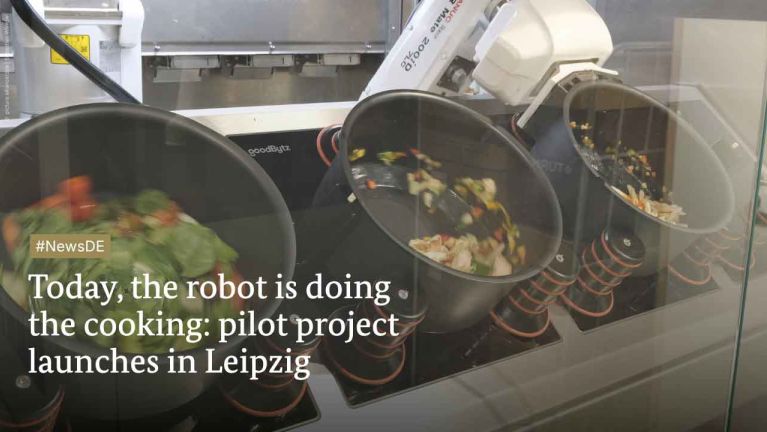
It’s lunchtime at Camp Walker, a US military base in South Korea. Soldiers are waiting to receive their meal from a black container. Behind a glass panel, the cook is hard at work selecting ingredients, stirring, dividing the food into portions and preparing one dish after another. He never needs a break. That’s because the cooking here is being done by a robot developed by Hamburg-based food tech firm Goodbytz.
Why is the military using cooking robots?
Military catering poses a logistical challenge. In conventional set-ups in the field, teams prepare the meals at a central location, package them up and then transport them to the troops. Sometimes the food is lukewarm at best by the time it reaches them. A study by the National Research Council in the US revealed why: it can be six to seven hours after cooking before the meals are actually served up.
It is precisely delivery times like these that autonomous kitchen systems aim to shorten by preparing meals closer to where the troops are stationed and serving them up when they are needed. This relieves the burden on personnel while at the same time making fixed mealtimes less important.
How does a mobile robotic kitchen operate?
Alongside its stationary robotic kitchens, Goodbytz has developed a mobile system in a transportable 20-foot container. A kitchen in a standardised container can be relocated with comparative ease and deployed in places lacking any stationary canteen facilities. “This means we can reliably supply meals even if personnel is in short supply or in situations where meals are required around the clock,” says Hendrik Susemihl, Goodbytz CEO and co-founder. If necessary, the container kitchen can be run off a generator. An integrated refrigeration system keeps ingredients at the right temperature during transport. According to the company, the robot chef can serve up 30 freshly prepared dishes within a matter of minutes.

The same principle is used byMunich firm Circus SE. It has likewise developed a mobile robotic kitchen for defence and civil protection applications. The insulated containerised system is designed to maintain stable temperatures and storage conditions to ensure that it remains operational even in challenging situations. The company claims that the system can keep up to 40 meals ready for serving at one time. “In war and crisis situations, keeping military personnel fed is just as important as keeping them well equipped,” says CEO Nikolas Bullwinkel.
Where are German-made robotic kitchens already being deployed?
The US military is already using Goodbytz systems at several locations: it has a stationary robotic kitchen at Camp Walker in South Korea and also uses the mobile system as a field kitchen. Another autonomous kitchen system made by Goodbytz is installed at the US military’s Fort Hood base in Texas. “The fact that our technology is now in use on one of the biggest military bases in the US is a strong sign of how robotics is set to change the way catering is organised,” says Susemihl. The US military has already ordered 20 other cooking robots from Germany.

Circus SE has also landed its first military clients. In early 2026, the company was awarded a contract to supply the Bundeswehr - Germany’s armed forces - with a cooking robot and also won a public procurement tender to provide its autonomous meal-supply technology to the Lithuanian Armed Forces on NATO’s eastern flank. In July, this was followed up by a cooperation agreement with the Ukrainian armed forces. Ever since, the robot-assisted technology has been helping supply the troops of the 3rd Assault Brigade of the Ukrainian Ground Forces in the Kyiv area.
The mobile kitchens aren’t intended only for military personnel, however. If infrastructure breaks down or large numbers of people need to be quickly catered for, they can also be deployed for example following natural disasters or in emergency shelters. The cook behind the glass panel may not be dishing up meals only to soldiers in future, in other words.
Dieses YouTube-Video kann in einem neuen Tab abgespielt werden
YouTube öffnenThird party content
We use YouTube to embed content that may collect data about your activity. Please review the details and accept the service to see this content.
Open consent form

