Exploring society through food
The German Archive of Culinary Arts is far more than a collection of recipes. It is an invaluable source of information that enables researchers to explore food culture as a part of German history.
 Luca Rehse-Knauf
 “Food is a total social phenomenon,” says Janosch Förster from the German Archive of Culinary Arts in Dresden. This means that by exploring food culture and culinary matters, it is possible to paint a bigger picture of a society. Food history reflects social circumstances, global trade relations, economic crises – global politics, in a nutshell.
One example of this is the menu of the state banquet held on the occasion of John F. Kennedy’s visit to Germany in 1963. The German Federal Chancellor Konrad Adenauer and the Governing Mayor of Berlin, Willy Brandt, received the US President in Berlin’s city hall. “If you take a closer look at the menu, you will find a great deal of political symbolism,” says Andreas Rutz, a historian at TU Dresden. “Fillet of beef Renaissance style” is among the dishes on the menu. “In this context, in West Berlin in 1963, this evokes memories of America’s reconstruction aid.” The lettuce hearts and the ice cream were named after Kennedy’s wife Jacqueline and his daughter Caroline.
More than everyday culture
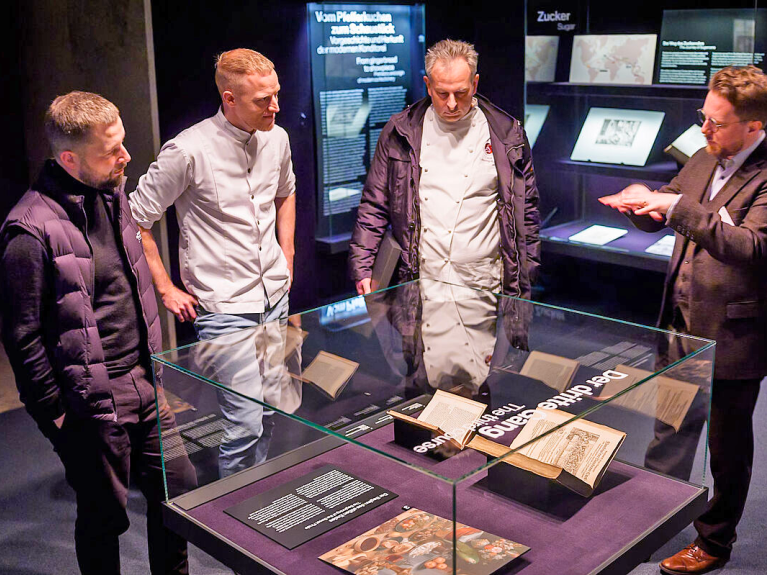
This telling menu card is just one of tens of thousands of documents kept at the German Archive of Culinary Arts in Dresden. The archive is dedicated to collecting and researching evidence of eating and cooking culture. The items in the collection include manuscripts, historic as well as present-day cookbooks and thousands of menu cards and restaurant menus.
One of the main research topics is the so-called area of culinary aesthetics, which is characterised by a holistic view of the experience: the way food is presented, its taste, smell and textures, as well as dining culture and rituals. “We think of food as a synthesis of the arts,” Andreas Rutz explains. The archive aims to close a gap with this approach, as research tends to focus on everyday culture and dietary habits.
The German Kitchen Miracle
Rutz and Förster emphasise that the culinary arts in Germany were shaped strongly by the decisive developments of the 20th century: the end of the culture of imperialism, two world wars and the division of Germany. It was not until the 1970s and 1980s that internationally acclaimed high-end gastronomy re-emerged in Germany in the form of the so-called German Kitchen Miracle (Deutsches Küchenwunder). The two historians also believe that Germany’s culinary landscape is shaped strongly by regional cuisines. While many dishes are similar, they can have different names in different places or be prepared slightly differently.
The collection of the German Archive of Culinary Arts is a source of inspiration for researchers and cooks alike, including some star chefs.


