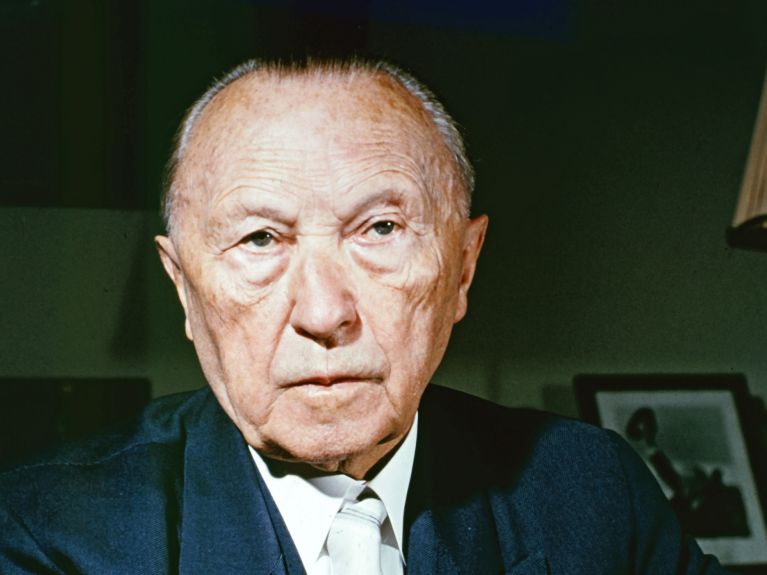
Konrad Adenauer – the founding chancellor
Born 150 years ago, Konrad Adenauer shapes the nascent Federal Republic of Germany as its first chancellor, the architect of Western integration - and a polemical and ruthless politician.
 Wolf Zinn
 It is a historic moment: as president of the Parliamentary Council, Konrad Adenauer proclaims the Basic Law of the Federal Republic of Germany on 23 May 1949 in Bonn; the new constitution transforms West Germany, which lies in ruins, into a constitutional democracy. Adenauer talks of a “new chapter in the eventful history of our nation”. A few months later, on 15 September, the Bundestag (the country’s parliament) elects the then 73-year-old with a one-vote majority as the first Federal Chancellor. For a period of 14 years until October 1963, he shapes the form and direction of the new state.
From mayor of Cologne to opponent of the Nazi regime
Konrad Adenauer is born in Cologne on 5 January 1876, the third of five children of Justice Secretary Johann Konrad Adenauer and his wife Helene, née Scharfenberg - in the relatively humble circumstances of a Catholic civil servant’s household. Adenauer studies law and enters into local politics at a young age. He becomes mayor of Cologne in 1917, modernises the city, promotes business and in 1921 additionally becomes president of the Prussian State Council.
When the National Socialists come to power, Adenauer draws the attention of the Nazi regime. He refuses to welcome Adolf Hitler at the airport in 1933, and prohibits swastika flags on the city’s bridges. Soon afterwards he is deposed by the new rulers. Adenauer is even put in prison following the attemptedassassination of Hitler on 20 July 1944; he is released again after a few weeks when the church authorities intervene, however.
Though Adenauer opposes the Nazi dictatorship, he does not join any resistance group. Letters from this period reveal a politician who, though deeply troubled, is also thinking strategically and hoping for a new dawn after the Nazi regime. After 1945, he is one of the founders of the political party Christian Democratic Union (CDU) in the British occupation zone, takes over as its chairman in 1946 and works his way up to the pinnacle of West German politics.
Architect of Western integration
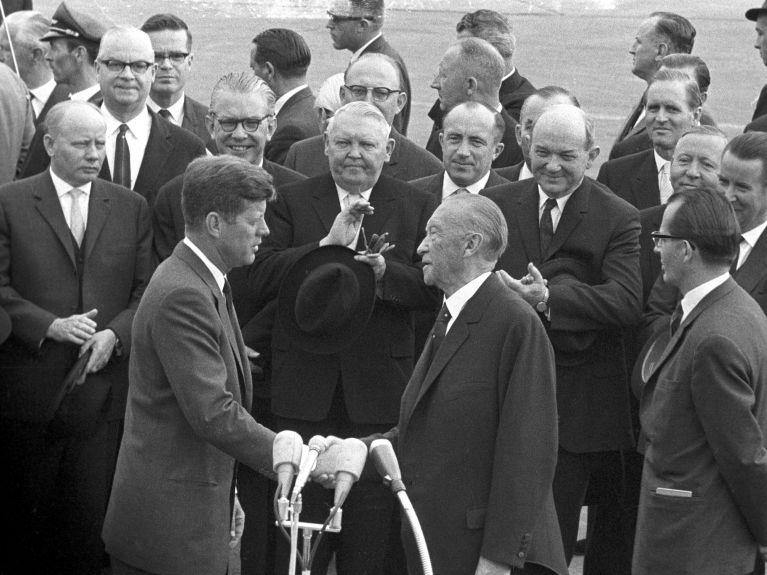
Adenauer’s political direction as chancellor is clear: he orients the Federal Republic towards the West and its political, economic and military structures. Despite huge reservations both at home and abroad, he establishes the Bundeswehr - the German armed forces - and begins rearmament in 1955. Under Adenauer’s leadership, the Federal Republic of Germany joins the Council of Europe and the European Coal and Steel Community, and later the Western European Union, NATO, the European Economic Community and Euratom. Germany thus evolves to become an internationally acknowledged state - at the same time, however, reunification becomes an ever more distant prospect and relations between the Western and Eastern Blocs become increasingly strained.
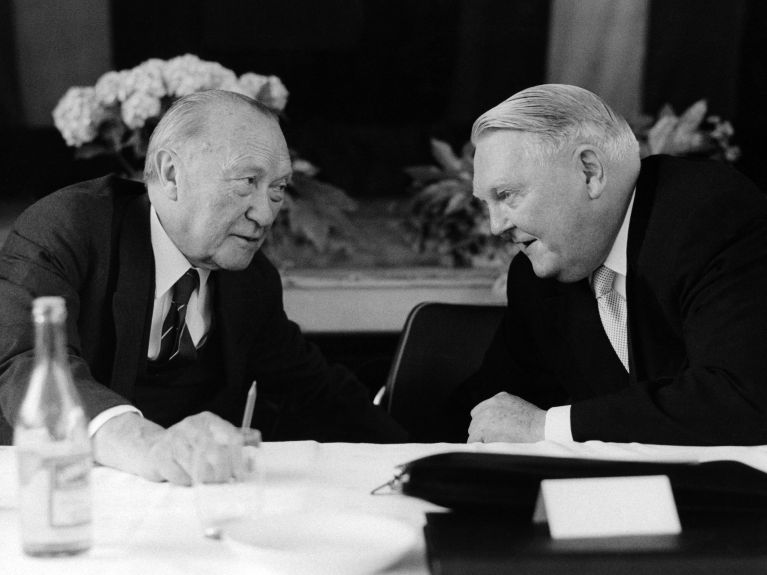
Adenauer believes that a social market economy based on the concepts devised by then Economics Minister Ludwig Erhard is the best way forward: on the basis of the 1948 currency reform, the Lastenausgleich (burden equalisation) – a major redistribution programme to compensate victims of war and displacement - and a broad-based welfare state pave the way for Germany’s “economic miracle” and stabilise the young democracy.
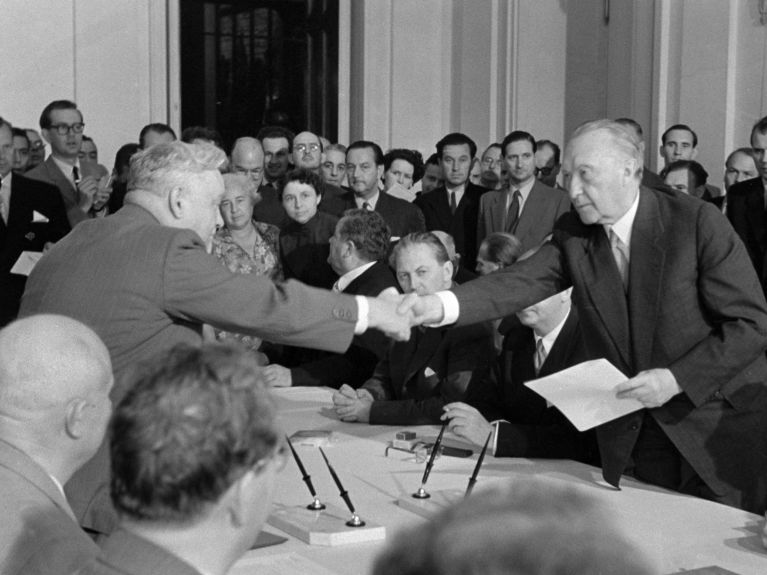
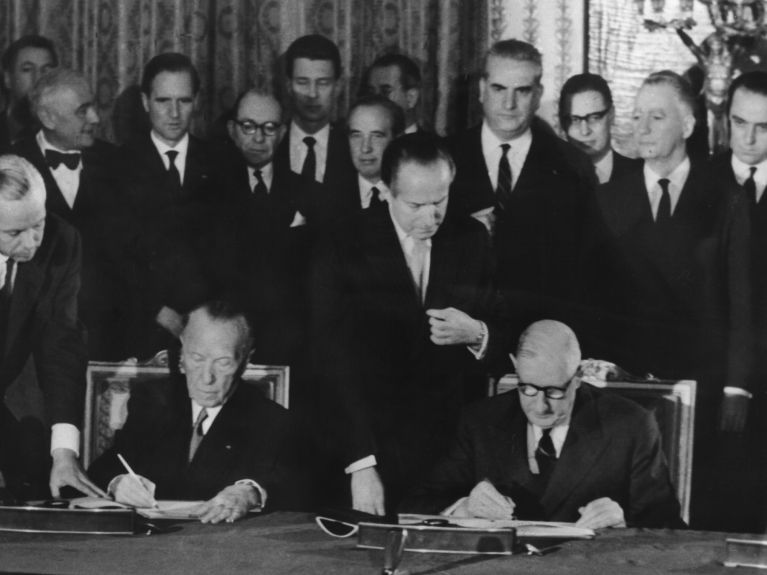
Adenauer takes many far-reaching foreign policy decisions: in 1952 he signs the Luxembourg Agreement with Israel and the Jewish Claims Conference – controversial at the time, this is a historic step towards reparation and the recognition of Germany’s responsibility. Adenauer travels to Moscow in 1955 and succeeds in getting German prisoners of war returned from the Soviet Union. In 1963, he and French President Charles de Gaulle seal Franco-German reconciliation when they sign the Élysée Treaty – the starting point for a close partnership, which continues to this day, between the two countries in a converging Europe. “We must create Europe to curb the expansionary ambitions of the Soviet Union,” he once says - an almost prophetic statement from today’s viewpoint.
Political calculation and blind spots
Adenauer governs with a clear instinct for power. He expands the Federal Chancellery to make it Germany’s nerve centre, dominates his party, parliamentary group and coalition partners, and uses the Federal Intelligence Service to keep his eye on political opponents - a practice that is in clear violation of constitutional principles.
Adenauer’s personnel policy is also highly contentious: he appoints Hans Globke, a former senior official of the Nazi regime, as a close colleague in the Federal Chancellery; numerous high-level civil servants in the federal ministries are former Nazi party members. The continuity of former elites is one of the dark chapters of the Adenauer era.
Dieses YouTube-Video kann in einem neuen Tab abgespielt werden
YouTube öffnenThird party content
We use YouTube to embed content that may collect data about your activity. Please review the details and accept the service to see this content.
Open consent formAdenauer’s authoritarian leanings are revealed again in the 1962 “Spiegel affair“ when he brands a critical investigative report published in German news magazine “Der Spiegel” about the Bundeswehr as an “abyss of treason” – at the same time, the resulting public outcry strengthens the freedom of the press and heralds the end of his chancellorship. Konrad Adenauer remains chairman of the CDU until 1966 and a member of the Bundestag until his death; he dies in Rhöndorf on 19 April 1967 at the age of 91.


