Pro & Contra
Would you go to war for your country?
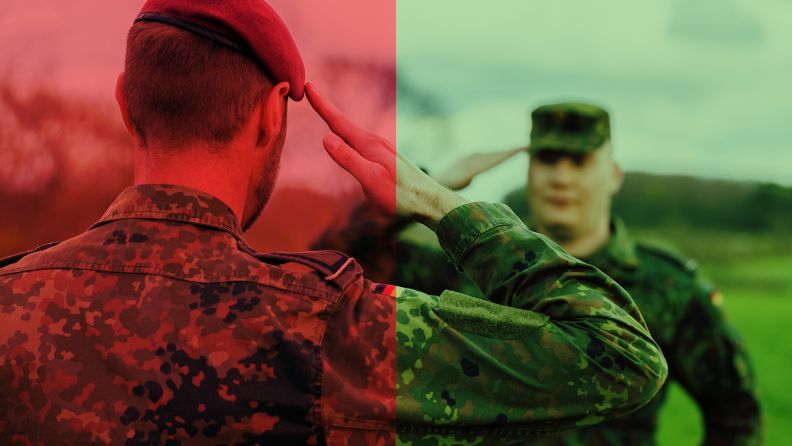
Should compulsory military service be reintroduced in Germany? Two young people are sharing their views on the issue.

Pro
Léocadie Reimers is working at ARX Robotics, a defence technology start-up. She is a navy reservist.

Contra
Ole Nymoen is an author, journalist and podcaster. His book “Warum ich niemals für mein Land kämpfen würde” (“Why I am never going to fight for my country”) was published in 2025.
What has shaped your personal attitude to compulsory military service?
After graduating from school I performed voluntary military service, so I am well-aware of what it means. And this is precisely why I am strongly in favour of it. However, the real reason for my attitude lies in our geopolitical reality: the security situation in Europe has shifted and this is having real-life consequences. The Bundeswehr is affected by a significant lack of personnel, and as a member of NATO and the EU, Germany bears responsibility. A society that takes this responsibility seriously must ensure the corresponding human resources requirements are met. Compulsory military service is the only way to do this.
At the start of the Ukraine war I noticed the thoughtless statements of many reporters. They are calling for arms deliveries and celebrating territorial gains, leaving out the part where human beings, who did not choose to be in this war, are dying, simply because the interests of their states happen to be incompatible. So I asked myself: what if Germany got actively involved in a war? I was concerned that we might end up in the same situation as Russia or Ukraine, where people are being sent to war against their will. A constitutional right to conscientious objection to military service exists in Germany. However, this right could be formally maintained but effectively hollowed out, for example by carrying out more comprehensive examinations of the motives of conscientious objectors.
What role does the state play for you, and what can it ask of its citizens?
The state is not a service provider you can choose to use or not at will. It is the essential legal basis on which any individual freedom is based. Those who benefit from such freedom also bear responsibility for the conditions that make it possible. This is a moral as well as a legal duty. And this is why the state can ask for whatever is needed to maintain this basis, as long as it does so in a way that is democratically legitimised. Without security there can be no rule of law, and without the rule of law there can be no freedom. Compulsory military service is therefore not an attack on personal freedom but an instrument for protecting it.
The state is the control structure I happen to be born into. I do not identify with Germany or any other state. It is irrelevant, what rights I would like to grant the state. In its constitution, the state authorises itself to require young men to perform mandatory military service in the event of war. I believe that these questions at the individual level are sham debates: the goal is to encourage young people to permanently reflect on whether and when they would be willing to fight. However, this does not determine the military prowess of any state.
In what sense is compulsory military service an issue of intergenerational justice?
The free democratic order we are benefitting from today was not achieved once and for all, but every generation is responsible for ensuring it anew. Those who simply enjoy its advantages without contributing anything to making it last are breaking an intergenerational contract. Without compulsory military service, this burden is spread unfairly across volunteers and allies. That’s not justice. This is why compulsory military service must apply to all, including women. And this is not limited to armed service: ensuring security also requires disaster control, fire fighting and medical care.
I struggle to understand the supposed intergenerational conflict. It is wrong to turn the young and the old against each other. This is already the case regarding pensions and now we are doing the same with military service. I’m not taking part in this. Preventing a war from happening should be in the interest of all generations. I do wonder whether all citizens have actually understood how serious the situation really is. German politicians and opinion makers are warning that a war could break out as soon as 2029, possibly in the Baltic states. And young people are to participate in this. I would like to remind anyone who argues that compulsory military service is a good idea, claiming that it “didn’t do us any harm either” that we are talking about their grandchildren here!
What is the other side’s strongest argument in your opinion, and why does it still not win you over?
The strongest counter-argument is a moral rather than a pragmatic one: war is generally wrong and no state can ever justify sending a human being to their death. This notion deserves respect. However, it is based on the assumption that all actors involved share the same moral standards. And that is empirically untrue. If one state refrains from defence while others do not it is acting negligently towards those it is supposed to protect. In addition to this, pacifism can only be articulated as a political position where security already exists, that is where democracy has successfully defended itself.
The strongest argument of the other side is that many freedoms are granted more generously in Germany than elsewhere, such as freedom of expression and freedom of movement. However, these rights are drastically cut in the event of war and are only fully reinstated once the war is over. This shows that the state does not regard these freedoms as valuable and does not think of them as an end in themselves, as is often claimed. Instead, they are granted or not depending on whether it’s beneficial to the state.


