One year in office: Germany’s government between crises and pressure to reform
In its first twelve months, the federal government has set foreign policy priorities and launched major reform projects in a difficult global environment.
 Wolf Zinn
 One year after taking office on 6 May 2025, Germany’s federal government is taking stock for the first time – at a moment when domestic political and economic challenges coincide with an extremely tense global situation. The black-and-red coalition of CDU/CSU (also known as the Union) and SPD is united above all by two goals: economic effectiveness and reliability in foreign policy. At the same time, the coalition is operating in a period marked by numerous conflicts, in which political priorities constantly have to be recalibrated and compromises found. And the pace has been high. In the first twelve months, the Cabinet met 41 times and adopted 557 measures, including 172 draft laws.
Foreign policy: networks, partnerships, Ukraine
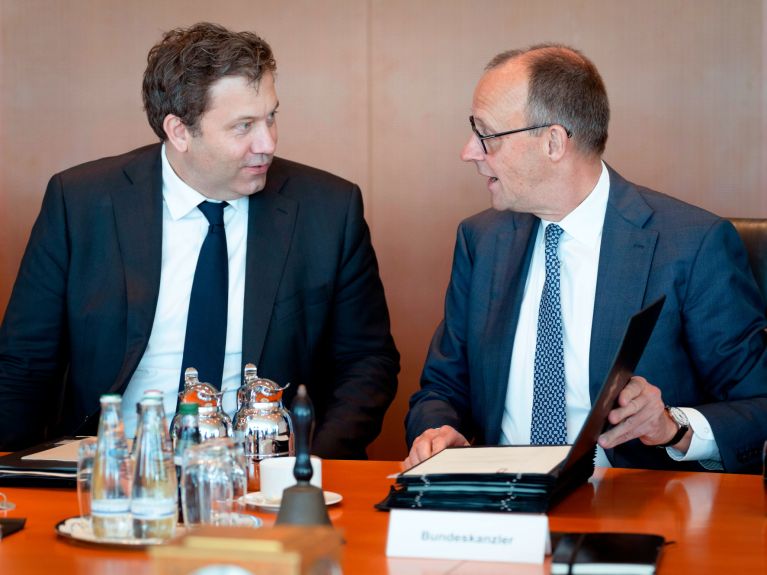
In the area of foreign policy, the federal government is seeking to expand and deepen partnerships, also beyond the EU and NATO. Federal Chancellor Friedrich Merz sees Germany as a proactive middle power in a multipolar world order. During his first year in office, Merz visited 30 countries, including the United States and China. Relations with the two major powers remain a balancing act: economic interdependence and security challenges must be reconciled with Germany’s ambition for greater sovereignty.
One key focus lies on closer partnerships with countries that are strategically important for energy, raw materials, trade and supply chains – such as India, Canada, the Gulf states and South East Asia, as well as partner countries in Africa and Latin America. At the same time, Germany is looking to take on a leadership role within the European Union and strengthen its effectiveness.
Ukraine remains at the centre of European security. Germany continues its comprehensive support for the country attacked by Russia and increasingly sees cooperation as a strategic partnership – in the military and economic sphere as well as in terms of reconstruction.
Defence: more funding, new coordination
In light of geopolitical upheavals, strengthening Germany’s and Europe’s defence capabilities is clearly a priority. By 2029, German defence spending is to rise to 3.5 per cent of GDP; by 2035, a further 1.5 per cent of GDP is planned for defence-related areas such as infrastructure, cybersecurity and intelligence services. At the institutional level, the federal government has established a National Security Council, a crisis task force and a situation centre in the Federal Chancellery. A new, initially voluntary military service model has been introduced with the aim of strengthening the personnel base of the Bundeswehr.
Business: investment signals
In order to give fresh momentum to a struggling economy, a new programme allows for declining-balance depreciation of up to 30 per cent per year for certain investments, while a gradual reduction in corporate tax is planned from 2028 onwards. Since the beginning of 2026, various instruments have also come into force that are intended to provide relief totalling around 10 billion euros per year for consumers – for example through the abolition of the gas storage levy and lower network charges.
Economic policy is complemented by the debt-financed special fund for infrastructure and climate neutrality (500 billion euros), through which the federal government aims to accelerate investment in transport infrastructure, schools and networks, for example.
Innovation: research as a competitive advantage for Germany
By 2030, at least 3.5 per cent of GDP is to be invested in research and development. The so-called Hightech Agenda brings together funding for key technologies such as artificial intelligence, quantum technologies, microelectronics, space and nuclear fusion – with the aim of making research more rapidly applicable in industry.
Migration: progress within a European framework
In its migration policy, the federal government points to declining asylum figures. Initial asylum applications fell by 51 per cent in 2025 compared to 2024 and by 66 per cent compared to 2023. This trend has continued into 2026. Returns of migrants have increased, too. In 2025, some 23,000 people were returned to their country of origin – 15 per cent more than in 2024 and 45 per cent more than in 2023. At the same time, the reform of the Common European Asylum System (CEAS) is to enable faster and more uniform procedures across Europe from 12 June 2026.
Current situation and outlook
The federal government has introduced an emergency programme in response to the current energy crisis resulting from the Iran war. From May 2026, energy tax on petrol and diesel is to be reduced by around 17 cents per litre for two months; at the same time, competition rules are being tightened.
At the end of April 2026, the coalition agreed on a healthcare reform. Further major and complex reforms are planned over the course of the year – particularly in the areas of pensions and long-term care policy.


