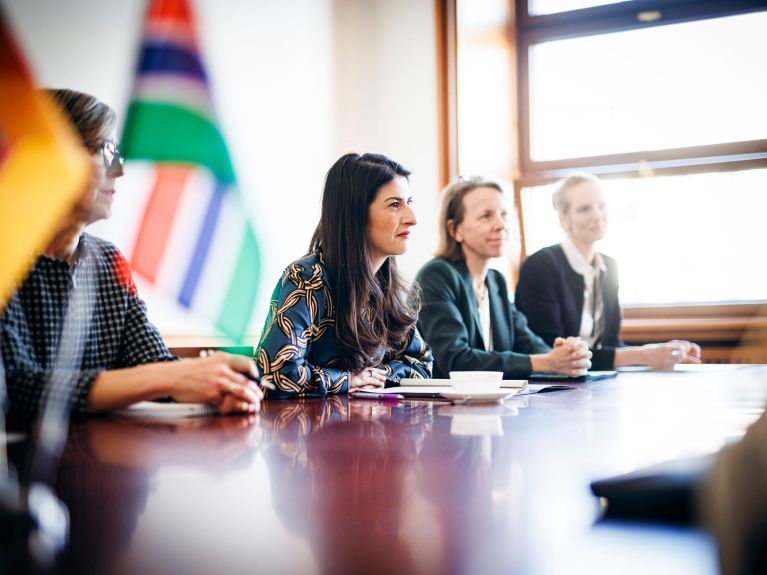
Why is Germany continuing to support the UN, Ms Güler?
The UN is being obstructed by some of its members and is struggling financially. Nonetheless, Germany wants to step up rather than reduce its engagement.
Ms Güler, Germany chaired the UN Peacebuilding Commission (PBC) in 2025. What were Germany’s duties in this capacity, and how do you view the outcome?
The PBC supports states - at their request - as they develop and implement peacebuilding strategies and measures. The national responsibility of the state in question and activities pursued in partnership are the primary focus. In our capacity as the PBC chair, for example, we supported Mauretania and Colombia in presenting their national peace consolidation efforts to the PBC. We also incorporated international development banks into the PBC’s work to a greater extent. In addition, we took steps to strengthen the Commission’s advisory role vis-à-vis other UN bodies, for example by advising the UN Security Council on the subject of women, peace and security. Overall, we can be very satisfied with what we achieved during our year as PBC chair.
In your opinion, what role do UN peacekeeping missions play in the current global political situation?
UN peacekeeping missions play a central role in international efforts to preserve peace and security. The “Blue Helmets” symbolise the UN’s responsibility for peace and security more than almost any other instrument. In crises, they make a key contribution to stabilising the situation. That’s why Germany takes part in peacekeeping missions with soldiers, police officers and civilian experts. Of course, as conflict dynamics become increasingly complex, UN peacekeeping missions need to evolve and adapt to today’s challenges. This includes ensuring closer integration with civilian instruments of conflict prevention and peace consolidation. By hosting the UN Peacekeeping Ministerial in Berlin in May 2025, Germany’s Federal Government made an important contribution to readying UN peacekeeping missions for the future.
Germany is a staunch supporter of the United Nations.
Germany is applying for a non-permanent seat on the UN Security Council in 2027/2028. What does Germany have to offer?
In times of great crisis, Germany is a staunch supporter of the United Nations. Our commitment takes many different forms; we are for example the second-largest contributor to the UN system. Because of our commitment to peacekeeping, stabilisation, humanitarian assistance, climate and environmental protection and economic cooperation, we build bridges to all UN states and strengthen our partnerships even with small states. We are keen to assume responsibility within the framework of the United Nations and make an important contribution to peace and security. In line with our motto of “Respect - Justice - Peace”, we see membership of the Security Council as our responsibility to all member states.
The UN is currently facing many challenges - both political and financial. Why is Germany continuing to support the UN nonetheless?
In an era of escalating global crises and conflicts, there is simply no alternative to the United Nations, and especially to the Security Council as a central institution of the international community, when it comes to peacekeeping and conflict management - but they do require special support. Germany can and wants to provide this support. We have been a central supporter of the organisation, its institutions and the principles of the UN Charta for over 50 years. The UN is the only organisation with members worldwide. It embodies the multilateral world order and international law. We want - and have a duty - to strengthen it, especially in times of growing polarisation and rivalry. That’s why we are actively committed to pushing ahead with necessary reforms of the United Nations and the Security Council, and to strengthening the UN system as a whole.


