New momentum for electric mobility in Europe
Germany’s automotive industry has launched an ambitious endeavour to catch up in the field of battery manufacturing. The goal is to increase independence from Asian competitors.
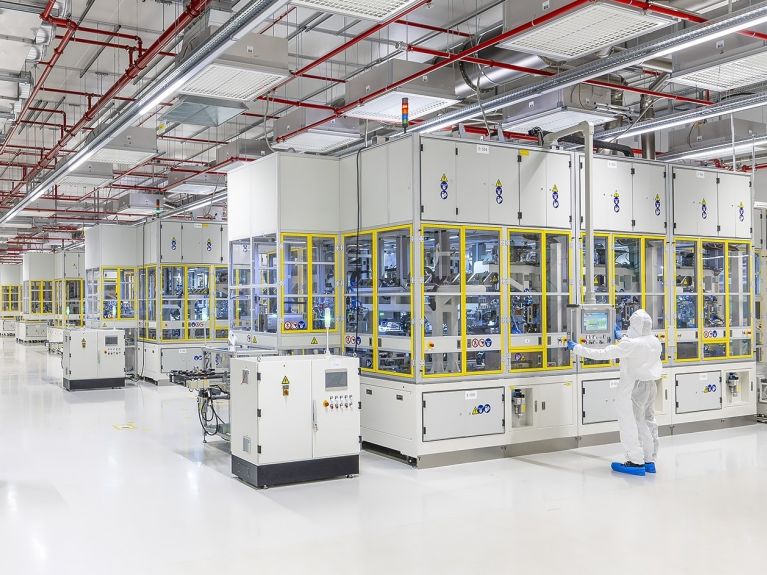
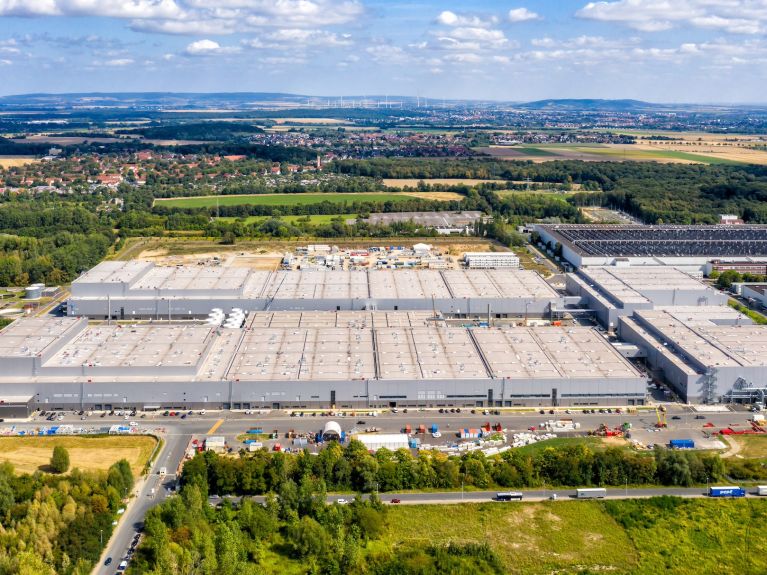
The world of electric mobility was stirred up when the Volkswagen subsidiary PowerCo opened a so-called gigafactory in Salzgitter in Lower Saxony in late 2025. It is the first plant to produce unified cell battery technology on a large scale. “The PowerCo gigafactory in Salzgitter is setting a strong sign for Europe as a technology hub,” says Oliver Blume, CEO at VW. “We are the first European car manufacturer to establish our own battery cell development and production facilities.”
China is the market leader for batteries
Experts have in fact been describing the project in Salzgitter as a milestone and an industrial turning point. European car manufacturers had neglected the issue of storage technology for a long time and were believed unable to keep up in terms of technology. The Chinese manufacturer CATL has been the market leader for electric car batteries since 2017. China produced some 70 percent of global battery capacity in 2024, according to a study conducted by the advisory company Deloitte, while North America and Europe accounted for 11 and 13 percent, respectively. However, only three percent of the batteries produced in Europe are actually made by European manufacturers. Forecasts suggest that almost half of all batteries will still be produced in China in 2030. Planning provides for the European share to go up to 25 percent, but most of these batteries will still be produced by non-European manufacturers.
The EU has been supporting European battery manufacturers for quite a while, albeit with very limited success. Many projects have been put on hold or were found to be unprofitable. “A large share of battery projects initiated in Europe in recent years have failed, for example due to a lack of access to critical raw materials, high capital requirements, operational inefficiency and the slow pace of electric mobility uptake,” says Harald Proff from Deloitte. “European companies will be paying a high price if they fail to seriously catch up in the area of battery production.” The battery is, after all, the most expensive component in a vehicle and determines its performance, price and ultimately the entire European automotive industry’s ability to compete.
Unified cell for electric cars around the world
European car manufacturers have meanwhile developed a number of concepts for creating their own production ecosystems. In this context, Volkswagen has now chosen the extraordinary approach to rely on a unified cell and gigafactories, planning to soon open two further plants in addition to the Salzgitter factory. The unified cell is based on a standardised architecture, allowing it to be used in all car models around the world and thus leading to a considerable decrease in vehicle prices. In addition to this, the unified cell is compatible with all chemical battery processes that are currently being discussed.
The industry is becoming increasingly optimistic that Europe could bring about a trend change for cell production and the entire ecosystem. “Efforts to close gaps in material cycles and ensure local supply have caused a new wave of investments,” says Ciara Cook from New Automotive, a British think tank. In addition, the EU Commission has announced a so-called Battery Booster worth 1.8 billion euros that are earmarked for increasing independence from Chinese products and improving supply chain diversification. More funding might be made available in the new EU budget.
There is another area in which Germany could reclaim lost ground: research. The Fraunhofer Research Institution for Battery Cell Production FFB in Münster was able to produce the first lithium-ion battery cell made exclusively with European production technology. The Federal Government invested 750 million euros in this project, and the State of North Rhine-Westphalia contributed another 320 million euros. “Batteries are essential for climate-neutral mobility and energy generation. This is why the first FFB PreFab battery cell represents a key milestone on our way towards batteries made in Germany,” says Dorothee Bär, the German Minister of Research, Technology and Space.
Electric car market is kicking back into gear
Sarah Michaelis from the Association of German Mechanical and Plant Engineering (VDMA) points out that while the manufacturing processes are generally considered technically complex, European machinery and plant manufacturers do have the expertise needed for covering the entire battery cell production process. “To be able to ensure sustainably competitive value creation we now need orders from customers and political support.”
PowerCo benefitted from this type of support: planning, approval and realisation took place at an impressive pace. This allowed for a new company that developed a competitive product and set up an entire cell factory including the associated supply chain to be established in just three years. Not only the European automotive industry but also Volkswagen itself is likely to benefit from this high speed in the medium term, as the electric car market has recovered noticeably in Germany in 2025, and the bestselling battery-electric car models were built by the VW Group.
Dieses YouTube-Video kann in einem neuen Tab abgespielt werden
YouTube öffnenThird party content
We use YouTube to embed content that may collect data about your activity. Please review the details and accept the service to see this content.
Open consent form

