“We plant water here”
Two locations in Germany, two contrasting weather landscapes: dust over Brandenburg’s fields, wind on a small marsh island in the North Sea. People describe how the weather shapes their everyday lives.
 Clara Krug
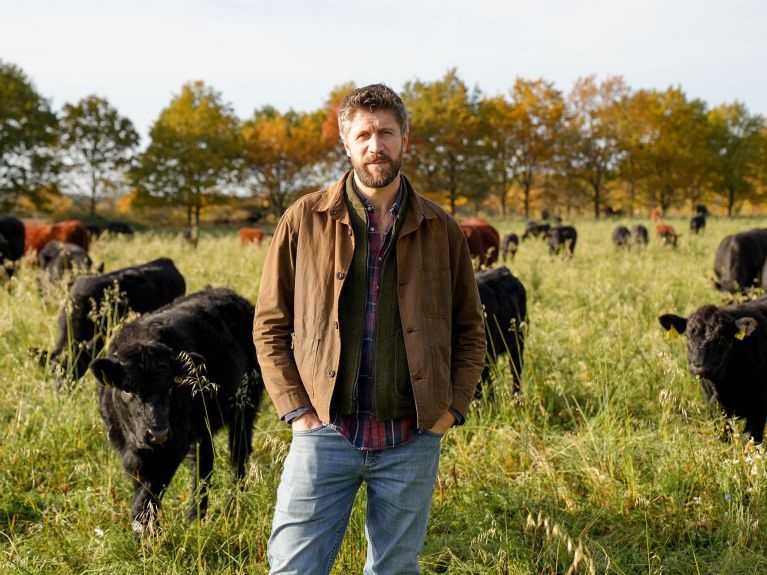
 Benedikt Bösel, farmer at the organic farm Gut&Bösel in Brandenburg
“When I drive along the tracks to my fields, the car often leaves a huge cloud of dust behind it. Dust is everywhere: on the windows, the car, even on your skin. This happens very quickly in spring and summer, especially if it hasn’t rained for a few days. Our soils in Brandenburg are very sandy. In the past the weather was more predictable. Today it shifts much faster because of climate change. The fluctuations are greater, and we feel the impact of that directly in our fields.
We’ve just had an unusually long winter. Two and a half months of frost, sometimes dropping to minus 15 degrees at night. And then suddenly everything changed very quickly. Within just a few days the water warmed up – 10 or 15 degrees during the day. But the frost came back at night. That’s difficult for the plants. They start growing, form buds, and then suddenly it goes very cold again.
We manage around 3,000 hectares of land, including 1,000 hectares of farmland and 2,000 hectares of forest. If no rain falls now, drought can develop quickly. That’s why our main focus is making the soil more resilient. Here we make use of cows and trees. The more humus there is in the soil, the better it can store water. We don’t plough any more. Instead we try to keep plants growing in the fields as much as possible, which the cows then graze. We also plant rows of trees across the fields. They slow down the wind and help keep moisture in the soil. That’s why we say: “We plant water here”.
In the end, though, everything still depends on the rain. When I lie in bed at night and hear the drops falling on the roof, it’s one of the most beautiful sounds there is.”
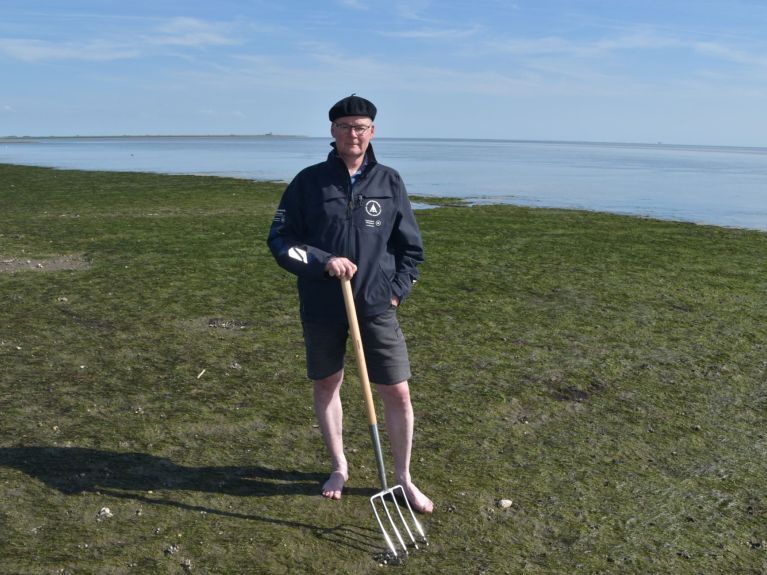
Michael Klisch, mayor of the North Sea marsh island Hallig Hooge and mudflat guide
“The weather determines everything here. The first thing I do when I switch on my computer in the morning is check the weather forecast. Not casually, but very deliberately: wind direction, water levels, the rain radar. All of that determines what my day will be like – as mayor and as a mudflat guide.
Right now everything is wet. Up until a few days ago there had been an unbroken layer of snow on the island since the beginning of January – a real exception. For weeks everything was white, the sounds were muted, as if the island were under a glass dome. Now the snow is melting. The ground is still frozen, and there are puddles across the meadows and roads. It rained heavily last night.
What’s typical for this island is the wind. Wind is not an event here – it’s the norm. In winter temperatures are often only a few degrees above zero. The damp, cold wind draws the warmth out of the houses – and out of your body, too.
As a mudflat guide, I have to make the decision every day whether or not I can take visitors out onto the mudflats. Rain isn’t a problem with the right clothing. But you can’t dress for thunderstorms: if that’s the forecast, we have to cancel the tours. And then there’s climate change. If sea levels rise, storm surges reach higher levels, and on our island that increases the risk that land will be flooded more often and for longer. We call that Landunter: tidal inundation.
And then there’s the ferry – our lifeline. If I want to go to the mainland for a doctor’s appointment or training course, it’s the wind and tides that decide whether it’ll be possible or not. Sometimes the ferry runs at a different time, sometimes not at all. If that happens, I miss connections and appointments have to be postponed. But even that can have its positive side. When everything outside comes to a halt, you might spontaneously visit your neighbour for a cup of tea. Here, the weather always has the final say.


