Why the art of compromise is so important in Germany.
Political scientist Herfried Münkler talks about Germany’s culture of compromise, its historical roots and whether compromise can also prove problematic at times.
 Interview: Wolf Zinn
 Professor Münkler, Germany is nowadays seen as a country that prefers to resolve conflicts by means of negotiation and compromise. Is this primarily a lesson learnt from the catastrophic events of the twentieth century, or does this tradition date further back - perhaps to the Holy Roman Empire, which was fragmented in political and religious terms?
Some historians may still remember the compromises that were common practice in the Holy Roman Empire of the German Nation, but this will not be present in the minds of the political elite, with the exception of a few individuals. Certainly there will be some form of collective memory that has influenced and lives on in political practices and rituals without those concerned necessarily being aware of it. However, in German history there have also been political phases during which the term “uncompromising” came to be synonymous with a determined and resolute approach, such as under Wilhelm II and during the Nazi era. When these phases led one after another to disaster, compromise as a mode of democratic government took centre stage again. That said, one reason why democracy failed in the Weimar Republic was that the political parties were not able to agree on the necessary compromises.
Which lessons were learnt from this as far as the post-1945 political order of the Federal Republic of Germany was concerned?
In Germany’s Basic Law, as was already the case in the Weimar Constitution, the need to compromise is an integral feature of the election system of proportional representation. In the history of the Federal Republic of Germany, there has been only one legislative period during which one party had the absolute majority, namely from 1953 to 1957. In all other cases, coalition governments have had to be formed; the coalition negotiations themselves already constituted a very significant compromise that was then followed by many smaller compromises. This fact, and the federal structure of the Republic, played a greater role in the emergence of Germany’s culture of compromise than any influence of the Holy Roman Empire, which ceased to exist in 1806.
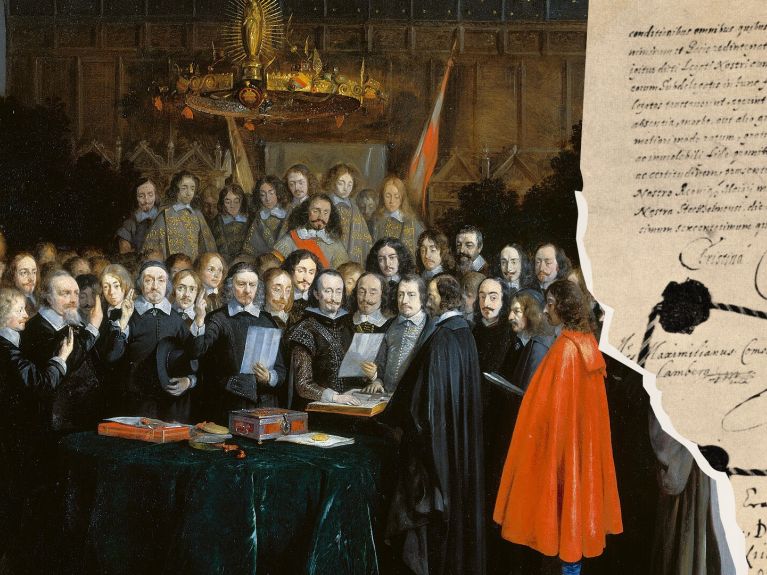
If we delve even further back into German history, which lessons learnt during the Thirty Years’ Warpaved the way for the Peace of Westphalia in 1648?
First, the realisation that none of the warring parties had any realistic prospect of victory any longer - especially not the Viennese House of Habsburg and Bavarian-led Catholic League, which had long regarded themselves as being on the road to victory. The defeats they suffered at Jankau and Zusmarshausen significantly increased their willingness to sign the peace treaty that had already been negotiated in Münster and Osnabrück. It was long the case that the peace negotiations - to turn Clausewitz’s famous aphorism around - were merely a continuation of war by other means, namely with the pen rather than the sword. The negotiating position changed in line with the prevailing situation on the battlefield. Which in 1648 was far from rosy for either side: some of the mercenary armies were refusing to take direct orders from political rulers, choosing to plunder the peasantry rather than fight the enemy. The war had taken on a life of its own. Peace had to be agreed in order to regain control of the situation.
Wenn wir nochmals weiter zurück in die deutsche Geschichte blicken: Welche Erfahrungen des Dreißigjährigen Krieges waren entscheidend dafür, dass der Westfälische Frieden von 1648 möglich wurde?
Zunächst einmal die Erfahrung, dass keine der gegeneinander kämpfenden Parteien eine realistische Aussicht auf den Sieg mehr hatte, schon gar nicht das Wiener Kaiserhaus und die von Bayern geführte katholische Liga, die sich lange auf der Siegerstraße gesehen hatten. Die Niederlagen, die sie bei Jankau und Zusmarshausen erlitten hatten, haben ihre Bereitschaft, den in Münster und Osnabrück bereits ausgehandelten Friedensvertrag zu unterschreiben, deutlich erhöht. Lange Zeit waren die Friedensverhandlungen, um Clausewitz zu variieren, eine Fortführung des Krieges mit anderen Mitteln, also ein Kämpfen mit der Feder anstatt dem Schwert. Die Verhandlungsposition veränderte sich mit der jeweiligen Kriegslage. Und die war im Jahre 1648 für beide Seiten nicht rosig: Teile der Söldnerheere hatten sich der politischen Direktionsgewalt entzogen und führten Krieg auf eigene Faust, also gegen die Bauern, die sie ausplünderten, und nicht mehr gegen die gegnerischen Heere. Der Krieg hatte sich verselbständigt. Man musste Frieden schließen, um seiner wieder Herr zu werden.
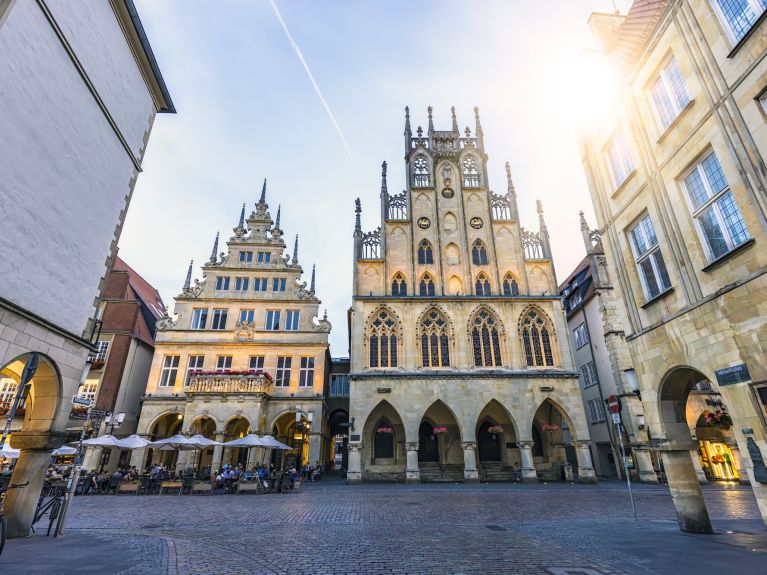
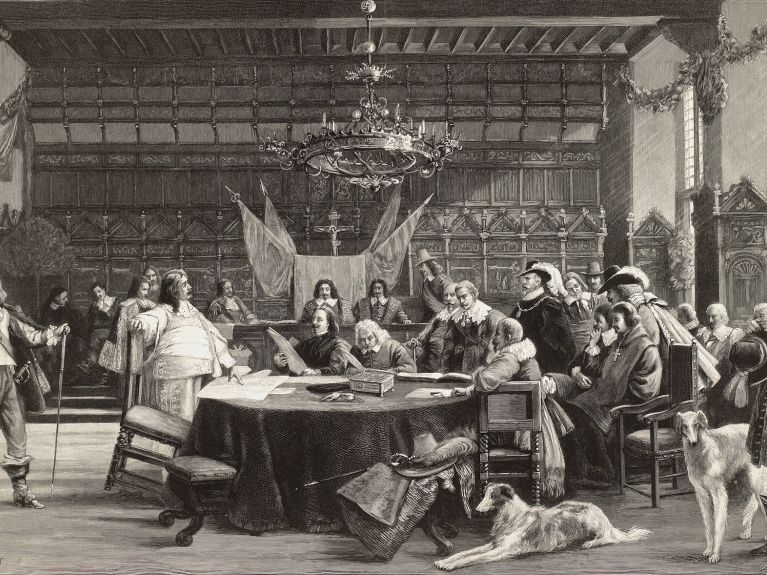
Can any direct line be drawn from the Peace of Westphalia to today’s Federal Republic of Germany?
Hardly. Until the Second World War, the Thirty Years’ War, with its horrendous numbers of casualties and devastation of entire swathes of land, had epitomised everything that should never happen again. Post-1945 this landmark event in the collective memory was overwritten by the Second World War, and this remains the case to this day.
Compromise isn’t always possible - nor indeed does it always make sense.
Is the German culture of compromise a strength in times of crisis - or can it also serve to thwart necessary and rapid decision-making?
Both. Compromise is a political instrument that can be used to address challenges. But that isn’t always possible - nor indeed does it always make sense. Truly strong political cultures combine the two - compromise with decisive, targeted action - according to the political situation, that is to say taking the challenges and their own resources and capabilities into account. To be able to choose intelligently between these two paths, what is needed is a political class with sound judgement - and in democracies a majority in the population that also has this ability. A lack of sound judgement is one of the key vulnerabilities of democracy.
In this context, do you see any link to the rise of the partly right-wing extremist party AfD?
The popularity the AfD is currently enjoying is due in part to the rejection of the culture of compromise in Germany. Authoritarian parties are always the ones that profit when compromise is scorned. The desire for an uncompromising approach goes hand in hand with a preference for authoritarian leaders.
Sehen Sie dabei einen Zusammenhang mit dem Erstarken der in Teilen rechtsextremen Partei AfD?
Der Zuspruch, den die AfD aktuell findet, ist auch das Ergebnis einer Ablehnung der Kompromisskultur in Deutschland. Autoritäre Parteien sind stets die Profiteure einer Verachtung von Kompromissen. Der Wunsch nach Kompromisslosigkeit und die Präferenz für autoritäre Führungsfiguren gehen Hand in Hand.
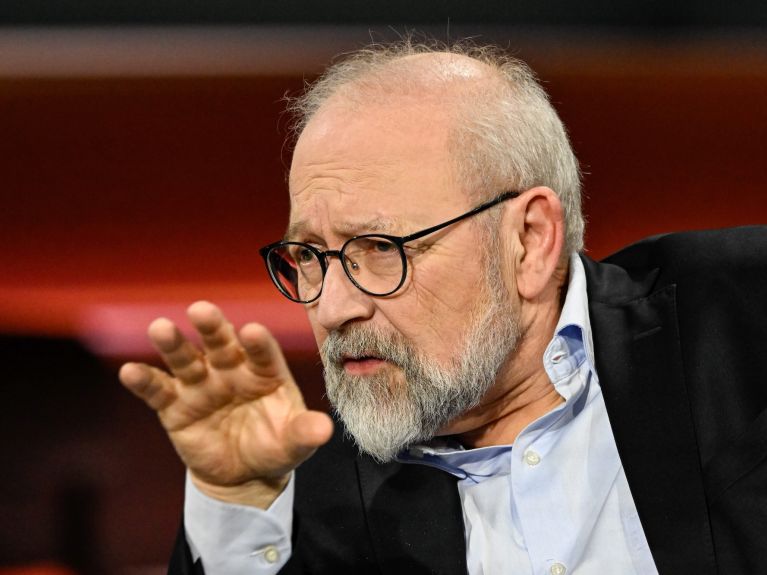
Professor Herfried Münkler is one of Germany’s leading political scientists. Until his retirement in October 2018, he taught at Humboldt-Universität zu Berlin. Münkler has published numerous books about politics and history.


