“I have rights – but so do others”
Why should I care about the Basic Law? A civil-society organisation informs pupils about fundamental rights in everyday life – and where the limits are.
 Helen Sibum
 At the beginning of the demonstration, everything is going smoothly. Young people march through the city centre, chant their demands and make noise with whistles. But suddenly tensions rise and some participants get aggressive. How should the police officers accompanying the march react? At what point are they allowed to break up the assembly? There are very high legal thresholds for this, because the Basic Law guarantees freedom of assembly. Breaking up the demonstration is a last resort: before doing so, the police always has to consider other options such as excluding individual troublemakers.
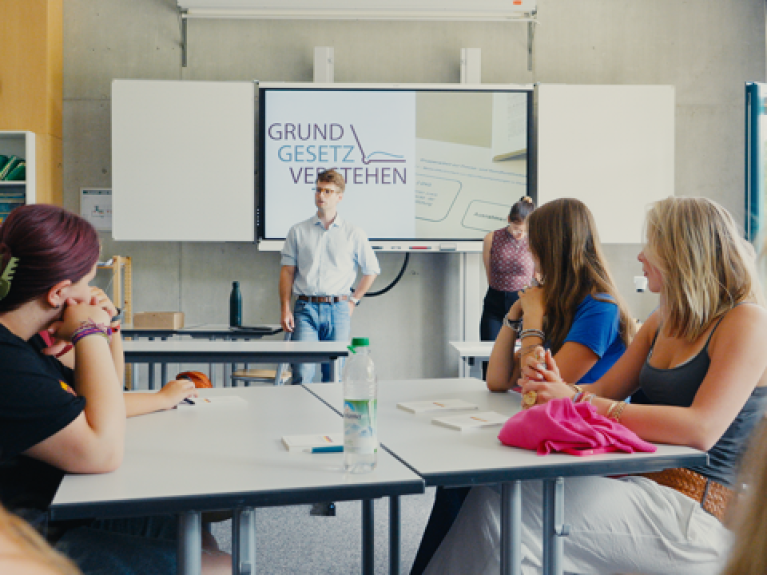
In this case, however, the demonstration is only a simulation. The school pupils planned it themselves. They studied the city map, selected a route and completed the registration form for their local public order office. Two coaches from the association GrundGesetzVerstehen guided them through the exercise.
10,000 pupils reached to date
The association was founded by law students from Germany. The idea is to explain democratic and liberal values to young people in a simple and accessible way. More than 180 members are now involved. Since 2021, they have reached more than 10,000 pupils.
When you organise a public assembly, you have to do so in a way that doesn’t unreasonably interfere with the interests and rights of others.

During a teaching unit on freedom of assembly, the coaches also discuss with the young people whether the authorities might object to their chosen route – for example because the demonstration blocks access to a hospital. Noise levels might also be restricted if the route passes a school. Demonstrations do not require official approval in Germany, but they must be registered and the relevant authority can impose conditions. “When you organise a public assembly, you have to do so in a way that doesn’t unreasonably interfere with the interests and rights of others,” says Lukas Schlegel, lawyer and board member of GrundGesetzVerstehen.
What do I want to pass on to the pupils? An appreciation of what it means to live in a functioning constitutional state governed by the rule of law.

Lena Müller-Westphal is also actively involved in the work done by the association’s board. What does the doctoral law researcher want to pass on to the pupils? “An appreciation of what it means to live in a functioning constitutional state governed by the rule of law. And an understanding of how fundamental rights work – and where their limits are.” “We encourage young people to weigh things up: I have rights – but so do others.”


