Debating takes practice
Arguing competitively: young people at German schools and universities learn how to discuss contentious issues fairly.
 Wolf Zinn
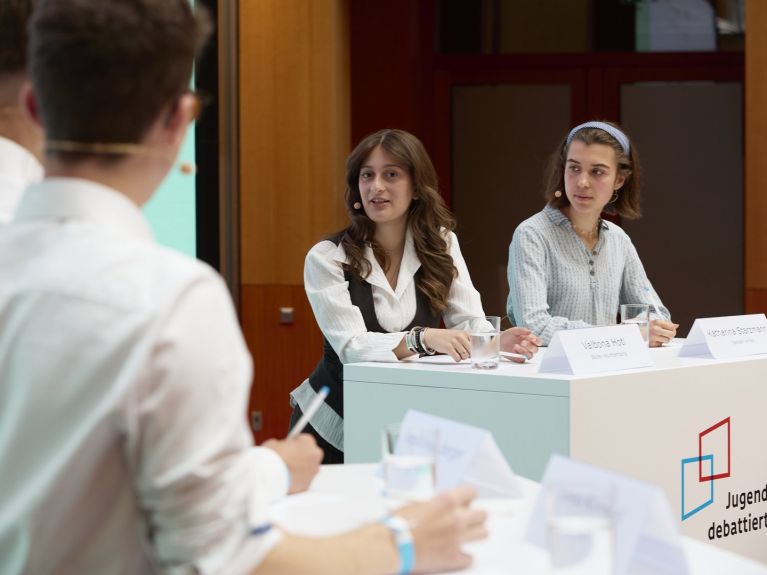
 Should the age of criminal responsibility be lowered from 14 to 12? This thorny issue is being discussed in Germany at the moment - and causing headaches even for established political and legal experts. At the 2025 national finals of Germany’s youth debating competition “Jugend debattiert“, it was 15- and 16-year-old school students who argued the pros and cons – in front of an audience of around 600 and an expert jury in Berlin.
Ian Pantel from Nuremberg argued that some of the children in question knew perfectly well that what they were doing was wrong - so they could also be held to account.
Emma Knop from Hamburg countered that children under 14 lack the maturity to properly judge the consequences of their criminal acts. Emma’s arguments convinced the jury and she came first in her age group.
The second question was no less controversial: should a national agency be established to fight disinformation? Valbona Hoti from Ellwangen said no. The 16-year-old fears that such an agency could acquire too much power and thus undermine trust in democracy. She won first place because, in the jury’s opinion, she argued the point in the clearest and most balanced way.
Dieses YouTube-Video kann in einem neuen Tab abgespielt werden
YouTube öffnenThird party content
We use YouTube to embed content that may collect data about your activity. Please review the details and accept the service to see this content.
Open consent formYoungsters practise constructive debate
The nationwide youth debating contest “Jugend debattiert” was established in 2001 under the patronage of the German president. Ever since, around 200,000 youngsters at participating schools all over Germany have been discussing every conceivable issue - in a respectful and solution-oriented manner. In addition, thousands of pupils who are learning German in nearly 40 other countries worldwide take part in an international competition. Federal President Frank-Walter Steinmeier sums up the democratic goal of this government-funded educational programme: “We need fair and lively debate, not fake news.”
Debating societies: arguing the pros and cons at tournament level
Those wishing to indulge their passion for debate after leaving school will find plenty of opportunity to do so at German universities – where around 70 debating societies hold numerous tournaments. Debates are subject to strict rules here, too: it’s about putting forward logically structured arguments and making rhetorically sophisticated responses - and ultimately about being more persuasive than your opponent. The highlight of the year is the annual German-speaking Debate Championships. The scene is by no means limited to the German language, however: many clubs also debate in English, their teams taking part in international contests such as the World Universities Debating Championship (WUDC).


