How much disagreement can a democracy tolerate, Ms Baer?
Susanne Baer served for twelve years as a Federal Constitutional Court justice. She explains why it functions rather like a seatbelt in a constitutional state.
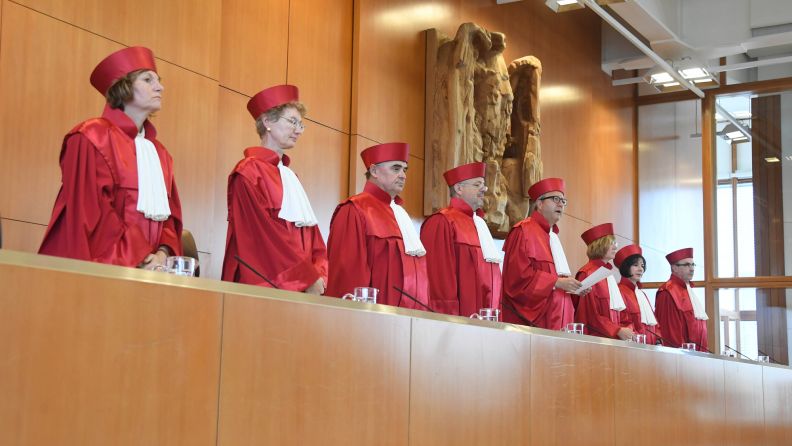
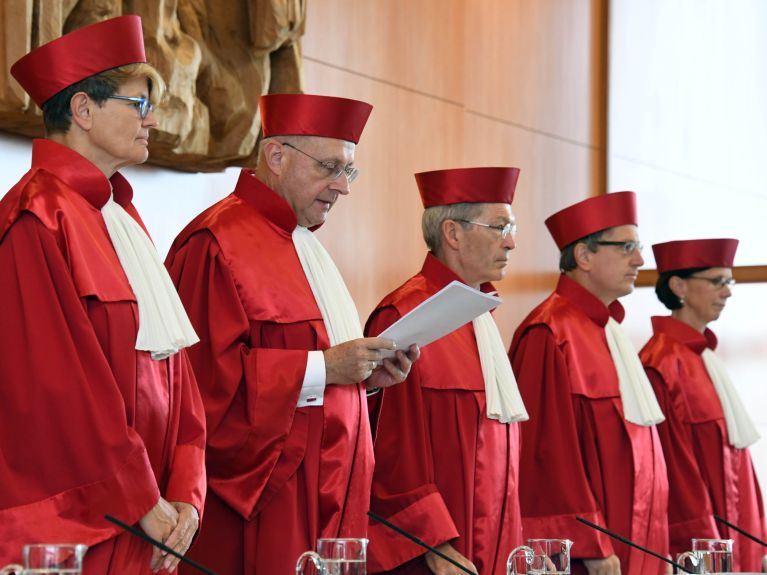
Football stadium bans, Covid-19 measures and Euro rescue packages. As a Federal Constitutional Court judge, Susanne Baer was involved in rulings on a range of contentious issues as diverse as life itself in Germany. Around 5,000 complaints are submitted to the court each year. They are filed by private individuals, organisations and state bodies alike, including from abroad.
Susanne Baer regards conflicts as an integral part of a democracy. She believes it is crucial for them to be resolved within the rules laid down by the Basic Law. A democracy can tolerate a lot of disagreement so long as the basic rights are preserved and independent courts are in place to monitor this.
The government, the opposition and ordinary citizens can request courts to assess state decisions. The Federal Constitutional Court provides the legal framework for this. It makes sure that disputes are resolved in accordance with firm rules and that the “law of the strongest” doesn’t apply. This is precisely what the legal expert regards as the constitutional state’s strength.
She writes in her book Rote Linien (Red Lines): “In a society in which there is dispute, constitutional courts decide how the argument may proceed and what is beyond dispute.“ Without such rules in place, dispute risks becoming simply a matter of strength.
The constitutional court functions rather like a seatbelt. It doesn’t constrict movement but does have a blocking effect in an emergency and prevents any serious injury.
Preserving basic rights
The duties of the judges: they ascertain whether a case impacts basic rights. These are the most important rights that everyone in Germany has vis-à-vis the state. They include the right to human dignity, freedom of expression, equality before the law and freedom of religion. If a law or court judgement could infringe these rights, the Federal Constitutional Court reviews the matter. It decides whether the regulation is compatible with the Basic Law or needs to be amended.
This is exactly what Susanne Baer sees as the central protective role of the court. “The constitutional court functions rather like a seatbelt. It doesn’t constrict movement but does have a blocking effect in an emergency and prevents any serious injury,” she explains. As such, the court has a protective role, especially in times of political crisis when democratic institutions come under pressure and societal conflicts are on the rise.
Limits to power
Time and again, the Federal Constitutional Court obliges policymakers to amend laws that violate basic rights. Obviously, such decisions won’t find favour with everyone - that’s life in a constitutional state.
“A constitutional court is no guarantee of a perfect democracy,” explains Baer. “But it does help ensure that legally enshrined rights cannot be simply ignored.”
The court decides not what is politically desirable but what is legally permissible.
“Giving substance to democracy is and remains the job of politicians,” writes Baer. “However, there are limits to their scope to do so: which ends at the point where basic rights are violated.”
A role model for courts worldwide
The Federal Constitutional Court rules on conflicts without having any instruments of power of its own. Its strengths are its arguments and trust in the constitutional state. The Federal Constitutional Court, which is headquartered in Karlsruhe, is also seen as a role model internationally. Many countries have set up their constitutional courts according to similar principles: independent judges, transparent proceedings and protection of basic rights.
“The existence of independent courts is an indicator of the state of a democracy,” writes Baer. “That’s why they are unpopular with anyone who does not accept any boundaries and wishes only to pursue their own interests.”
Born in 1964, Susanne Baer is a legal expert and professor at Humboldt-Universität zu Berlin. She served for twelve years as a Federal Constitutional Court justice. She also teaches and researches abroad, including in Europe and North America.

Established in 1951, the Federal Constitutional Court is the supreme court for constitutional matters in Germany. It ensures that laws and state decisions are compatible with the Basic Law. It can be called upon by citizens who feel that their basic rights are being violated, as well as by courts and organs of the state such as the Federal Government or Bundestag.