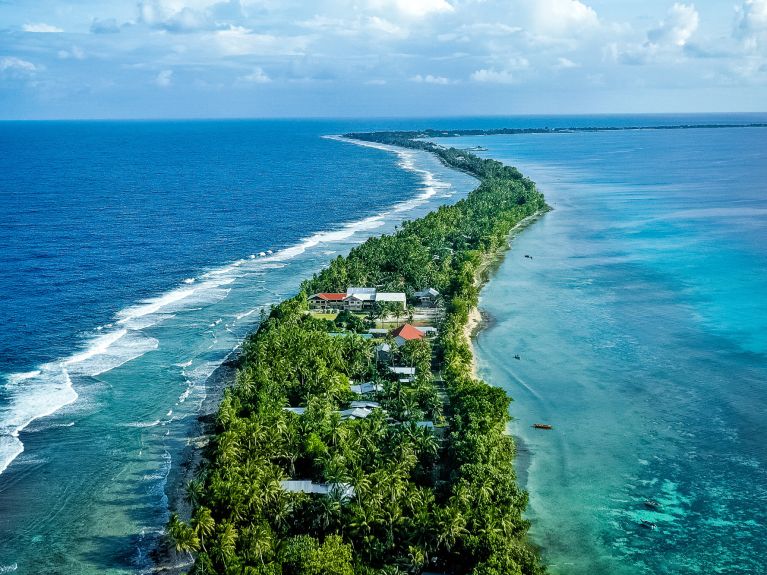
Does a nation still exist if it sinks beneath the waves?
Island nations like Tuvalu could soon disappear. The UN-coalition C-SET is also considering the ramifications under international law.
 Helen Sibum
 What is C-SET?
Rising sea levels are endangering entire island nations. Germany and Tuvalu have jointly grasped the initiative to raise awareness of this issue. At the United Nations in New York in 2003, they founded the “Coalition for addressing Sea-level rise & its Existential Threats” (C-SET). “It’s the first coalition in a UN context that deals with rising sea levels”, says Timo Stühm, First Secretary in the Permanent Mission of the Federal Republic of Germany to the UN. Ten further nations – affected countries and their supporters – are also involved in the coalition:
- Antigua and Barbuda
- Bangladesh
- Costa Rica
- Denmark
- Malta
- Morocco
- New Zealand
- Palau
- Romania
- South Korea
Why is Germany’ helping in this regard?
“Our helping these nations is a question of climate justice, of credibility and solidarity. They themselves didn’t contribute to climate change, but now they’re really suffering from its effects”, says Timo Stühm. “And rising sea levels are ultimately also affecting us in Germany, even if it’s not to the same extent.”
How does C-SET function?
The coalition organises summits and uses position papers and side events at the likes of the UN Ocean Conference to raise awareness of the threat. C-SET addresses four main areas:
- Climate action, climate adaptation and emission reduction
- Data availability and access, and knowledge transfer
- Aspects of international law
- Cultural preservation
These topics involved in rising sea levels will also be considered at the UN General Assembly in September 2026 in New York. A report on this issue by the UN General Secretary is also expected in the coming weeks.
What are the legal issues that emerge from rising sea levels?
“There is an intense debate on how international law protects nations threatened with extinction”, says Timo Stühm. This also involves the aspect of so-called national continuity: Can a nation continue to exist under international law even though its territory no longer physically exists or is no longer habitable? Germany takes a progressive stance in this respect, says Stühm. “We assume that this continuity does exist.”
Cultural aspects also play a role alongside legal and political issues. In what sense?
Rising sea levels also threaten the cultural heritage of the affected countries, in Tuvalu for example. That’s why the German Archaeological Institute is helping Tuvalu to digitise its tangible and intangible cultural heritage. Germany’s Federal Foreign Office is financing the project.


